- Mobile app development cost typically runs $40,000 to $600,000+, depending on complexity, platform, and how much AI the app needs to run.
- AI integration is now a standard line item. A third-party AI API (chatbot, recommendations) typically adds $8,000 to $40,000; a custom-trained model can add $50,000 or more.
- Fintech and healthcare apps cost more than a feature-equivalent consumer app, often $100,000 to $450,000, because compliance work (PCI-DSS, HIPAA) is real engineering time, not paperwork.
- Development consumes roughly 40 to 50% of a typical budget. Design and QA each run 15 to 22%, and skipping either to protect the coding line is the most common cause of cost overruns.
- In-house hiring is the most predictable cost path but not the cheapest: the U.S. Bureau of Labor Statistics puts the 2024 median software developer wage at $133,080/year (about $64/hour base, before benefits).
- Post-launch maintenance adds 15 to 20% of your build cost every year. Most first-time founders budget for launch and forget this recurring line item entirely.
You’ve got the idea. You’ve probably got a rough feature list scribbled somewhere. Then you ask three companies what it’ll cost, and you get back $55,000, $180,000, and $310,000 for the same app. That’s not a scam. It’s what happens when nobody has agreed yet on what “the app” actually means.
Here’s the honest answer. Mobile app development costs range from $40,000 to $600,000. A basic MVP sits near the bottom. An AI-native platform with real-time data and enterprise compliance sits at the top. Where you land comes down to complexity, the features, the platforms you support, the rules your industry imposes, and who writes the code.
This comprehensive guide breaks down how much does it cost to make an app across every critical dimension from platform choices and industry specs to regional rates and popular app clones, so you can budget accurately for your next digital build.
How Much Does It Cost to Build a Mobile App in 2026?
Mobile app development costs $40,000 to $600,000+ in the US in 2026. Simple apps start near $40,000, mid-complexity apps with integrations run $100,000 to $250,000, complex and AI-native builds run $250,000 to $600,000, and enterprise programs exceed $1 million.
Those are the bands we quote as a mobile app development company, drawn from the projects we scope and deliver. Two variables move the number more than everything else combined.
- Scope: how many user journeys the app supports, and how many of them need custom logic.
- Developers: since rates for identical skill vary by 70% depending on where the team sits.
| Cost dimension | How much it moves the number |
| Complexity tier | 15x between simple and enterprise |
| Feature set | $1,500 to $80,000 per feature |
| Platform strategy | 0.5x to 1.9x |
| Industry and compliance | +$25,000 to $80,000 in regulated sectors |
| Development stage mix | Discovery 8%, engineering 50% |
| Advanced technology | +$15,000 to $250,000 |
| Hiring model | 4x between offshore and US in-house |
| Team location | 4x to 6x |
| AI capability | +$8,000 to $400,000, plus a monthly bill |
The pattern worth noticing is that four of these are choices, not constraints. You can’t change your industry. You can absolutely change your platform strategy, your feature set, your hiring model, and your team’s location, and together those four account for most of the spread.
Have an App Idea and No Idea What It'll Cost?
Get expert guidance with a free consultation and receive a realistic estimate based on your app's features, goals, and development requirements.
Schedule Your Free ConsultationMobile App Development Cost Breakdown by Complexity
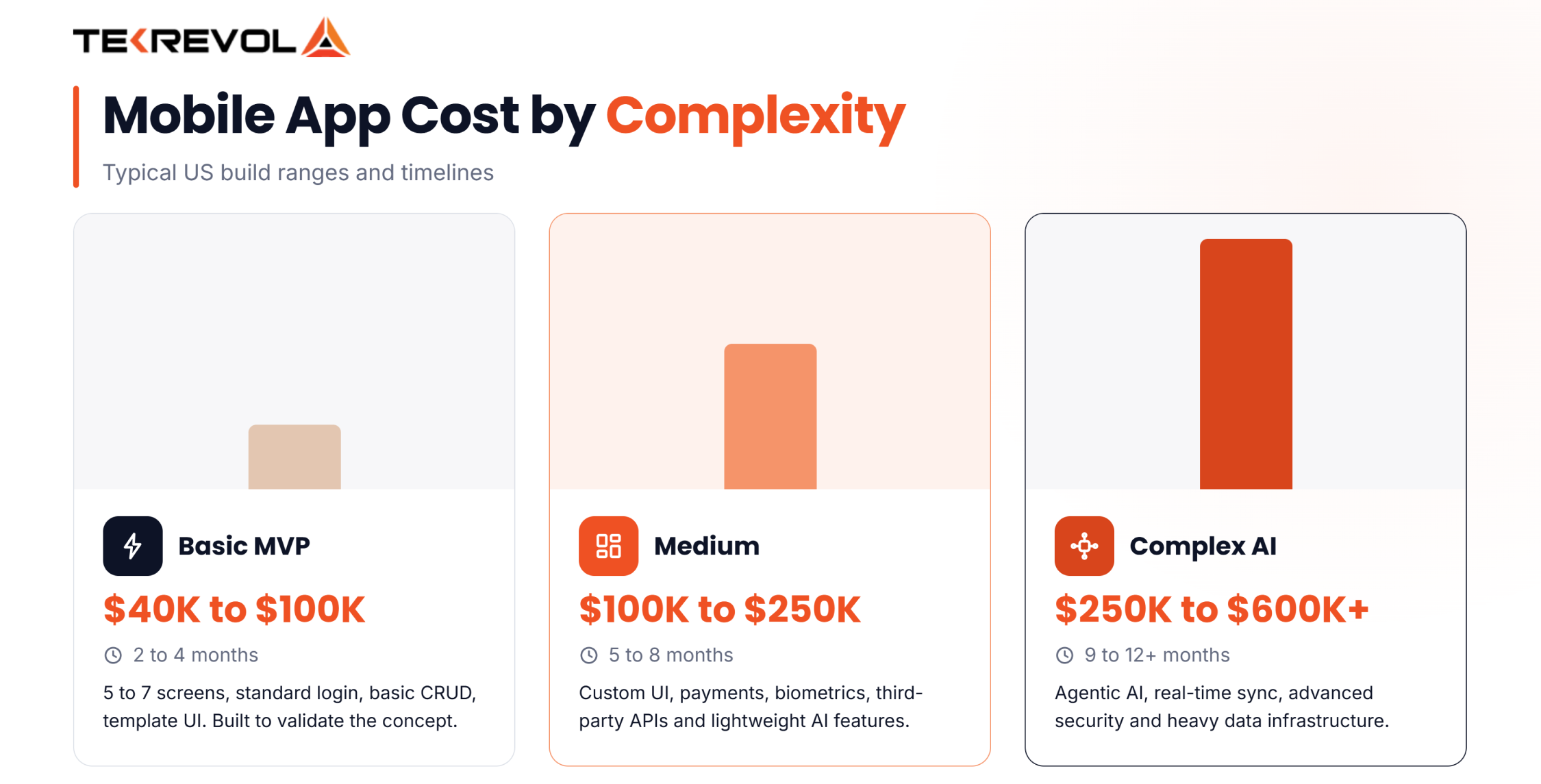
Mobile app development cost varies with feature count, custom animations, API integrations, and backend infrastructure. A basic app costs $15,000-$40,000, a mid-complexity app runs $40,000-$120,000, an advanced app costs $100,000-$250,000+, and enterprise-grade or AI-native apps start at $250,000 and can pass $600,000.
Here’s how the four tiers break down on scope, effort, and price.
| Complexity Tier | What’s Included | Typical Cost | Typical Timeline |
| Basic MVP | One core feature, simple UI, minimal backend | $15,000-$40,000 | 2-4 months |
| Mid-complexity | Multiple features, custom UI, API integrations, user accounts | $40,000-$120,000 | 4-8 months |
| Advanced | Complex logic, real-time features, multiple integrations | $100,000-$250,000+ | 8-12 months |
| Enterprise / AI-native | Custom infrastructure, heavy compliance, large-scale architecture | $250,000-$600,000+ | 12-18+ months |
Notice the overlap between tiers. That gap is testing and coordination. More moving parts mean more states to verify and more people who need to agree, and both scale faster than the code itself.
Simple Apps
A simple app does one job well and leans on managed services for the rest. Authentication, content, push notifications, and basic analytics all fit inside $100,000, and most ship on one platform inside five months. If your idea fits here, resist the urge to add “just one more thing” before launch.
Moderate Complexity
One feature usually causes the jump from simple to moderate. Payments does it. So does real-time chat, and so does anything that must work offline and reconcile later. Deferring a single one of those to version two often moves a project down a whole tier.
Complex Builds
Complex apps tie several systems together in real time. Most carry custom machine learning, detailed permission models, or a second app for drivers or merchants. Testing cost rises faster than build cost at this tier, so budget QA at the top of its range rather than the middle.
Enterprise Programs
Enterprise builds cost more for reasons that have little to do with the app. Single sign-on, ageing ERP systems, procurement cycles, security review boards and regional data rules all consume months. Set aside 20% to 30% of the program for that work alone, which is exactly why enterprise app development gets priced as a program rather than a project.
Which Features Affect Your Mobile App Development Cost?
Features drive cost more than screen count. Login and static content sit at $2,000 to $6,000 each. Payments, real-time chat, and live location run $12,000 to $30,000 each.
Every quote you receive is a feature list with a number attached. So the fastest way to control your budget isn’t negotiating the hourly rate. It’s deciding which of these you need in version one.
| Feature | Cost | Build time | Handles |
| User registration & login | $2,000 – $6,000 | 1 – 2 weeks | Social auth, password recovery, session handling |
| User profiles & settings | $3,000 – $8,000 | 1 – 2 weeks | Editable data, image upload, preference storage |
| Search & filtering | $5,000 – $15,000 | 2 – 4 weeks | Indexing, relevance, performance at data volume |
| Push notifications | $3,000 – $9,000 | 1 – 2 weeks | Segmentation, scheduling, delivery tracking |
| In-app payments | $12,000 – $30,000 | 3 – 6 weeks | Gateway integration, PCI scope, failure and refund states |
| Real-time chat | $15,000 – $30,000 | 4 – 7 weeks | Sockets, delivery guarantees, media, moderation |
| Maps & live location | $12,000 – $28,000 | 3 – 6 weeks | Map SDK, tracking accuracy, battery optimization |
| Booking & scheduling | $10,000 – $25,000 | 3 – 5 weeks | Availability logic, time zones, conflict handling |
| Video streaming | $20,000 – $60,000 | 5 – 10 weeks | Encoding pipeline, adaptive bitrate, CDN, DRM |
| Offline mode & sync | $15,000 – $40,000 | 4 – 8 weeks | Local storage, conflict resolution, queued actions |
| Admin dashboard | $10,000 – $30,000 | 3 – 6 weeks | Roles, reporting, content management, moderation tools |
| Analytics & reporting | $6,000 – $18,000 | 2 – 4 weeks | Event tracking, dashboards, export |
| AI recommendations | $15,000 – $40,000 | 4 – 8 weeks | Data pipeline, model selection, evaluation, tuning |
Payments, real-time chat, and offline sync account for the majority of scope creep. Each looks like one line on a feature list and behaves like a subsystem in practice. If a feature has failure you can’t describe, it isn’t one feature. Scope it separately or push it to version two.
Already have a feature list but no budget?
Send it over and we'll price it line by line, so you can see which features to keep, phase or drop before you commit.
Schedule Your Free ConsultationHow Does Mobile App Development Cost Vary by Platform?
Mobile app development cost by platform depends on whether you choose native code bases or cross-platform framework architectures.
Single native app development costs $40,000 to $120,000, while cross-platform builds cost $30,000 to $100,000, saving up to 40% on engineering effort. Cross-platform usually cuts 20-40% off the price of building two separate native apps.
Native iOS
Native iOS makes sense when your app leans on Apple-specific hardware, or when your early users are mostly on iPhone. It’s also the platform most B2B and premium consumer apps launch on first, since iOS users historically spend more per app. Our iOS app development cost guide breaks this down further.
Native Android
Device and OS-version fragmentation is the whole story behind Android app pricing. Expect 5% to 10% above iOS on identical scope. If your audience skews toward budget handsets, add QA hours rather than trimming them.
Flutter
Flutter renders its own widgets, so both platforms look identical without extra design work. That makes it the strongest pick for design-led products on tight launch dates. See the savings quantified in Flutter app development cost.
React Native
Already employ JavaScript developers? React Native is usually cheaper, because you reuse the team instead of hiring one. It relies on native modules more often than Flutter does, and that single factor drives most of the variance in a React Native cost estimate.
Also read: Native vs cross-platform development costs compared
Hybrid and Web-Wrapped
Hybrid looks like a bargain until you need a native capability the wrapper doesn’t support. Then you rebuild, and the saving disappears. We’ve inherited enough of those rebuilds to say it plainly, and hybrid app development cost sets out exactly where the ceiling sits.
What Is the Mobile App Development Cost Across Different Industries?
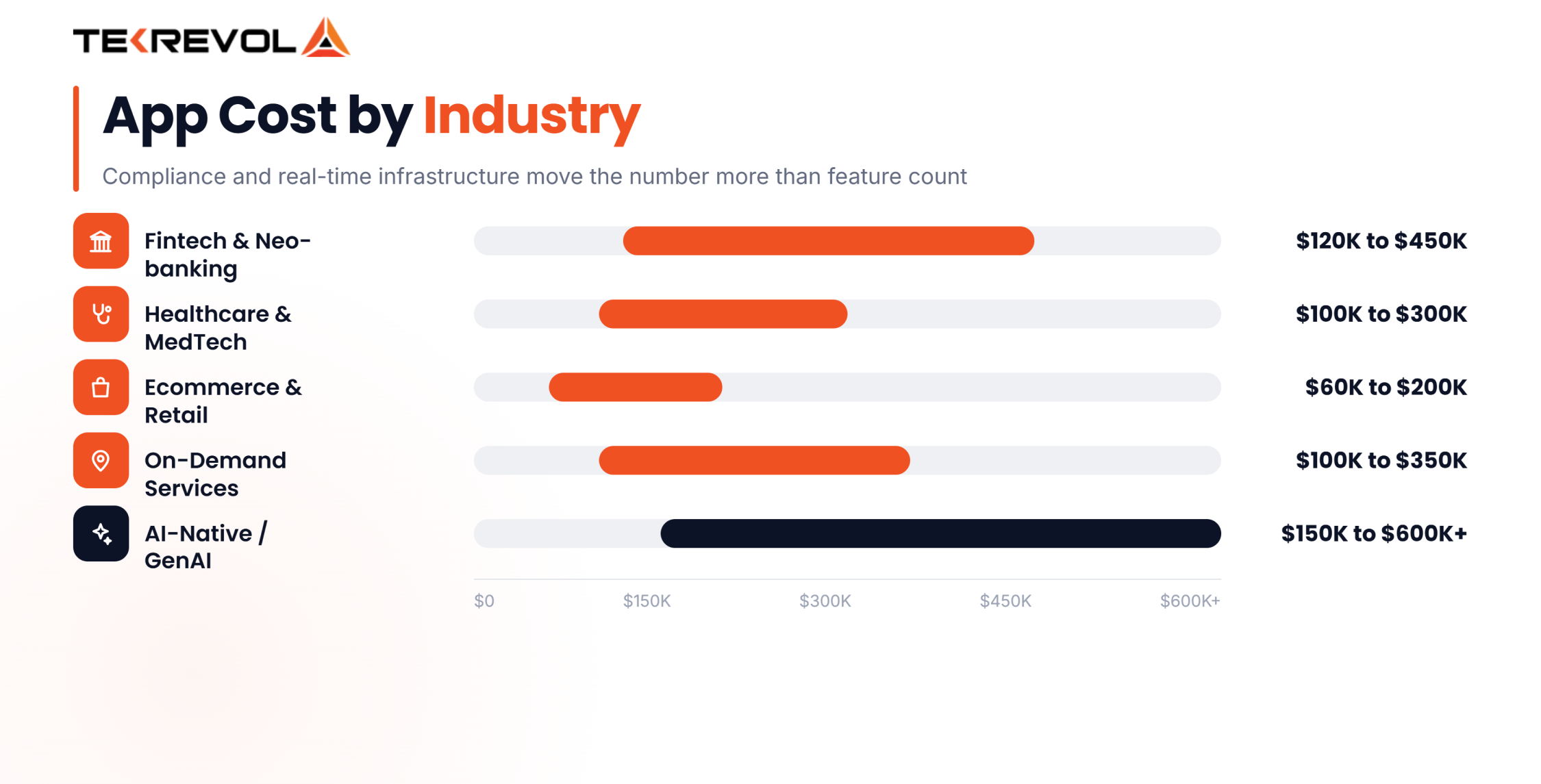
Mobile app development cost across different industries reflects specific security protocols, regulatory compliance mandates, and domain integrations. Specialized industry solutions range from $40,000 for standard retail apps up to $250,000+ for compliant fintech or healthcare platforms.
| Industry | Typical range | Primary cost driver |
| Healthcare & MedTech | $100,000 – $400,000 | HIPAA-grade infrastructure and audit trails |
| Fintech & neo-banking | $120,000 – $450,000 | KYC/AML, PCI scope, banking API certification |
| Retail | $60,000 – $200,000 | POS and inventory sync, loyalty logic |
| SaaS | $80,000 – $300,000 | Multi-tenancy, billing engine, usage metering |
| Ecommerce | $50,000 – $200,000 | Checkout edge cases, gateways, returns |
| Education | $50,000 – $180,000 | Content management, progress tracking, accessibility |
| Social media | $70,000 – $350,000 | Feed ranking, moderation, media pipeline |
| Mobile gaming | $60,000 – $500,000+ | Art production, physics, live-ops |
| On-demand services | $100,000 – $350,000 | Three connected apps plus live dispatch |
| Music & audio | $80,000 – $300,000 | Licensing, DRM, adaptive streaming |
| Real estate | $60,000 – $200,000 | Listing feeds, map performance, media weight |
Fintech
Fintech apps cost more even when the feature list looks modest. A fintech app needs KYC and AML checks built into onboarding before it can legally accept a single user. Our fintech app development cost guide breaks down exactly where that compliance budget goes.
Healthcare
Healthcare carries the steepest compliance premium of any vertical. Connecting to electronic health record systems is frequently harder than building the app, and a pre-launch security review isn’t optional. Every HIPAA line item is itemised in healthcare app development cost.
Ecommerce & M-commerce
Ecommerce budgets in 2026 rarely stop at a basic storefront. Shoppers expect smart discovery, fast checkout, and community-driven experiences. Catalogue size and personalisation depth drive ecommerce app development cost above all else. A thousand SKUs is a fundamentally different product from a hundred thousand, because search and filtering stop being trivial.
Retail
Retail apps are priced by their integrations, not their screens. POS systems, loyalty platforms, and live inventory feeds absorb the budget, and each one behaves differently. A typical integration stack is worked through in retail app development cost.
SaaS
SaaS apps run a different pattern. There’s less catalog work and more investment in multi-tenant architecture and subscription billing. A billing bug erodes trust fast, so this part of the build gets extra QA attention. Our SaaS application development cost guide breaks down what that architecture costs.
On-Demand Services
From delivery to home services, on-demand app development costs more because they’re really two apps: one for the user, one for the provider, synced through real-time dispatch and geofencing. The dispatch logic is almost always the hardest part and the easiest to underestimate.
Social Media Networks
Social apps are cheap to build and expensive to run. Moderation, media storage, and feed ranking all scale with users rather than features, so costs rise exactly when you succeed. Budget the running side using the cost to build a social media app.
Mobile Gaming Apps
Games are the one category where art routinely costs more than engineering. Live operations then continue indefinitely after release, which makes the total open-ended in a way other apps aren’t. Ranges by genre are broken out in mobile game development cost.
Music and Streaming App
Music and streaming apps carry a cost most people forget: content licensing negotiations that happen before a single line of code gets written. That’s on top of the streaming infrastructure itself. Our music streaming app development cost guide covers both.
Real Estate and Logistics
Both verticals live or die on data quality rather than interface polish. Listing feeds, mapping and CRM sync drive real estate app development cost, while route optimisation and fleet telemetry drive the logistics equivalent. In both cases, budget for data cleanup nobody warned you about.
Get Your Full 2026 App Blueprint and Consultation, Free
Most founders overspend by guessing their budget instead of scoping it. Get a professional cost breakdown before you commit.
Claim Your Free Consultation TodayPopular Apps & Their Development Cost Estimates
Cost to build popular clone apps reflects replicating proven digital business models like ride-hailing, video sharing, or e-commerce. Clone app development ranges from $40,000 to $180,000+ depending on scale and real-time backend complexity. Read these as a credible first version of the product category. The gap between those is several years and several funding rounds.
Ride-Hailing App like Uber
The cost to build an app like Uber reaches $100,000 to $300,000 because it’s three applications plus a dispatch engine. Customer app, driver app, admin console, and matching logic that assigns a driver in under a second while handling surge and cancellation.
Short Video Platform like TikTok
A TikTok-style app runs $150,000 to $500,000, and almost none of it is the interface. Video upload, transcoding, storage, adaptive delivery, a recommendation model, and moderation tooling are the actual product. Content delivery costs continue after launch and grow with success, so growth increases burn faster than revenue in year one.
Messaging App like WhatsApp
Building a messaging app like WhatsApp costs $70,000 to $250,000. Basic messaging is well understood. End-to-end encryption, guaranteed delivery, multi-device sync, and media at scale are not. Encryption is where the specialist work and the specialist rates sit.
Photo Sharing App like Instagram
The cost to make an app like Instagram runs $80,000 to $300,000. Feed ranking, image processing, stories infrastructure, and moderation carry the cost while the interface stays comparatively simple. Moderation scales with users, not with features, so it grows as a cost line rather than shrinking.
Fashion E-commerce like Shein
The cost to build an ecommerce app like Shein reaches $90,000 to $300,000. Catalog management across tens of thousands of SKUs, personalization, logistics integration, and a returns flow that works drive the number. Personalization is the differentiator and the expense.
Food Delivery App like Uber Eats
Food delivery app development cost runs $100,000 to $350,000. You’re coordinating customers, restaurants, and couriers in real time, splitting payments three ways, and tracking orders with accurate timing. Restaurant onboarding tooling is the piece founders consistently forget to scope.
Marketplace Delivery like DoorDash
The cost of developing an app like DoorDash matches Uber Eats at $100,000 to $350,000, with more weight on merchant tooling and dynamic pricing. The operational admin side is usually underestimated by half.
News and Publishing
A news app like Khaleej Times is the most affordable in this group at $50,000 to $150,000, because the content already lives in a CMS. The work is delivery: offline reading, push segmentation, personalization, and ad serving without wrecking performance. Regional publishers add localization and right-to-left support on top.
Multiplayer Gaming like PUBG Mobile
Multiplayer games carry netcode, anti-cheat, and an art pipeline that never really finishes. Live operations then continue indefinitely, so treat the launch figure as the beginning of the spend. Both phases are accounted for in building a gaming app like PUBG Mobile.
Discord (Community Chat)
Real-time voice at scale is the expensive part, and it’s an infrastructure cost as much as a build cost. Ten thousand concurrent voice users is a different product from a hundred. Build and running costs are separated in how to make an app like Discord.
Tabby (Buy Now, Pay Later)
BNPL apps are credit products wearing an app interface. Decisioning logic and regional compliance dominate the cost, and neither is visible in the user experience. Gulf market requirements shape the numbers in cost to build an app like Tabby.
How Much Does App Development Cost Vary by Location?
App development cost by location can vary by 5x for identical scope. US and Canadian teams charge $100 to $200 an hour. Western Europe runs $70 to $150. Gulf markets fall between, shaped by local compliance and language requirements.
Geography changes more than the hourly rate, which makes simple rate comparison misleading. Arabic right-to-left support, local payment rails and data residency rules all add genuine scope.
| Market | Hourly rate | Same mid-complexity app |
| United States | $100 – $200 | $130,000 – $310,000 |
| Canada | $80 – $150 | $100,000 – $230,000 |
| United Kingdom | $70 – $150 | $90,000 – $220,000 |
| UAE | $45 – $100 | $70,000 – $200,000 |
| Qatar | $45 – $95 | $65,000 – $190,000 |
| Saudi Arabia | $40 – $90 | $60,000 – $180,000 |
| Kuwait | $40 – $90 | $60,000 – $180,000 |
| Bahrain | $40 – $85 | $55,000 – $170,000 |
| South & Southeast Asia | $25 – $50 | $40,000 – $110,000 |
United Kingdom
UK builds run $90,000 to $220,000 at mid complexity, with London rates sitting well above the rest of the country. UK GDPR and data residency requirements add scope for anything handling personal data. Financial services carry additional regulatory weight. Our app development cost in the UK guide breaks the market down by city and sector.
Canada
Canadian builds land at $100,000 to $230,000. Rates sit slightly below US equivalents while timezone alignment stays intact, which is why Canadian teams are a common choice for US companies. Bilingual support is a genuine line item for national products. Our app development cost in Canada guide covers what French-language parity adds.
Saudi Arabia
Saudi builds run $60,000 to $180,000. Vision 2030 has driven serious demand, and government-adjacent projects carry local hosting and data residency requirements that shape the architecture. Arabic-first design is not a translation task. Our app development cost in Saudi Arabia guide explains what full RTL support actually involves.
UAE
UAE and Dubai builds sit at $70,000 to $200,000, the highest in the Gulf. The market is mature, the talent is competitive, and local payment gateway integration is standard scope rather than an extra. Free zone regulations affect data handling and the total app development cost in Dubai.
Qatar
The cost to build an app in Qatar runs $65,000 to $190,000. Government digital transformation programs drive much of the demand, and those projects come with their own security and hosting standards. Bilingual Arabic and English delivery is the default expectation.
Bahrain
Bahrain sits at the lower end of the Gulf at $55,000 to $170,000, with a strong fintech and digital banking sector thanks to a comparatively open regulatory environment. Financial licensing adds scope for fintech products. Our mobile app development cost in Bahrain guide breaks down the regional differences.
Kuwait
Kuwaiti builds run $60,000 to $180,000, with demand concentrated in ecommerce, delivery, and government services. Local payment integration and Arabic support are standard requirements rather than additions. Our mobile app development cost in Kuwait guide covers what changes for the Kuwaiti market specifically.
Freelancer, Agency or In-house: What Does Each Model Cost?
The team model changes the app development price more than any technical decision. Freelancers charge $20 to $80 an hour but carry delivery risk. In-house costs the most upfront. Agencies sit between, with accountability priced into the rate.
The US Bureau of Labor Statistics puts the median annual wage for software developers at $133,080 as of May 2024, with 16 percent projected growth to 2034. Before benefits, equipment, or management, one mid-level US developer costs roughly $64 an hour in base salary alone.
| Team model | Effective rate | Total for a $150K-equivalent build | Main trade-off |
| Freelancers | $20 – $80/hr | $50,000 – $130,000 | Lowest hourly, highest continuity risk |
| Offshore agency | $25 – $50/hr | $60,000 – $120,000 | Strong efficiency, communication overhead |
| Onshore agency | $100 – $200/hr | $150,000 – $350,000 | Full accountability at premium rates |
| Hybrid model | $50 – $110/hr | $90,000 – $200,000 | Balanced, needs a strong technical lead |
| In-house team | $180,000+/dev/year | $400,000+ in year one | Total control, slowest start |
Weighing an agency against building your own team?
We'll run the loaded cost of both models against your timeline and runway, so you can see the real break-even point.
Claim Your Free Consultation TodayHow to Budget Your App Development Cost by Stage
Mobile app development cost by stage breaks the life cycle into planning, design, core engineering, quality assurance, and deployment. Each phase absorbs a distinct percentage of your overall build budget.
Discovery takes 8% to 12% of the budget, design 12% to 18%, engineering 40% to 50%, QA 15% to 20%, and deployment 5% to 8%. Engineering is the biggest line, but discovery is where the total gets decided.
| Stage | What happens | Share of budget | On a $150,000 build |
| Discovery and scoping | Requirements, flows, architecture, risk mapping | 8% to 12% | $12,000 to $18,000 |
| UI/UX design | Wireframes, visual design, prototypes, design system | 12% to 18% | $18,000 to $27,000 |
| Engineering | Frontend, backend, integrations, infrastructure | 40% to 50% | $60,000 to $75,000 |
| QA and testing | Functional, device, performance, security, UAT | 15% to 20% | $22,500 to $30,000 |
| Deployment and launch | Store submission, release pipeline, monitoring | 5% to 8% | $7,500 to $12,000 |
Skipping discovery is the most expensive way to save money on an app. Investing in early scoping significantly reduces expensive rework during engineering.
-
Minimum Viable Product: Prioritizing an MVP development approach allows you to launch core features for $20,000 to $50,000, validating market demand before committing heavy capital.
-
Backend Infrastructure: Allocating backend development resources accounts for server database schema design, RESTful APIs, and cloud hosting architecture setups.
Also read: What it costs to publish an app on the App Store
How Does Advanced Tech Affect the Cost of App Development?
Emerging technology adds cost through specialist work, not longer code. Cloud infrastructure adds $10,000 to $60,000. AR, VR, and blockchain layers add $30,000 to $300,000, because the testing surface explodes and the talent pool shrinks.
| Technology layer | Added cost | Main cost driver |
| Cloud infrastructure | $10,000 – $60,000 | Autoscaling, redundancy, infrastructure as code |
| AR features | $30,000 – $150,000 | 3D assets, spatial testing, performance tuning |
| VR experiences | $50,000 – $250,000 | Headset targets, comfort testing, high-fidelity worlds |
| Blockchain layer | $40,000 – $300,000 | Contract audits, wallet integration, deployment risk |
| IoT connectivity | $25,000 – $120,000 | Firmware coordination, protocols, field testing |
| Metaverse environments | $100,000 – $500,000+ | Persistent worlds, avatars, concurrency |
Augmented and Virtual Reality
AR and VR app development cost adds $30,000 to $250,000 depending on depth. AR costs come from 3D asset production, spatial tracking accuracy, and testing in physical environments you can’t reproduce in a simulator. VR adds headset-specific targets and comfort testing to avoid motion sickness, which is an engineering constraint rather than a polish item.
Blockchain
Blockchain app development adds $40,000 to $300,000. Smart contract development, wallet integration, and on-chain design carry a permanence risk nothing else in software has, because you can’t quietly patch a deployed contract. Third-party audits alone cost $15,000 to $50,000, and skipping one isn’t a saving. It’s a deferred liability.
Cloud App
Cloud app development adds $10,000 to $60,000 to a build, covering infrastructure as code, autoscaling, monitoring, and multi-region redundancy where uptime matters. The bigger number is the ongoing bill, which scales with users and media volume rather than with features.
Metaverse
Metaverse development cost starts at $100,000 and passes $500,000 quickly. Persistent worlds, avatar systems, real-time concurrency, and asset pipelines each represent substantial engineering alone. Concurrency is what separates a demo from a product.
The AI Factor: How Intelligence Impacts App Costs in 2026
AI adds $8,000 to $600,000 depending on depth. Wiring a third-party model into an existing app costs $8,000 to $20,000. Custom recommendation logic runs $15,000 to $40,000. Training and serving a proprietary model starts near $50,000 and scales with usage.
This is the fastest-moving line in any 2026 budget and the most often misquoted, because AI carries an ongoing cost development quotes don’t capture. Token and inference fees are operating expenses, and they grow with your user base.
| AI approach | Best for | Build cost | Monthly Running Cost |
| Third-party API | Chat, summarisation, classification, generation | $8,000 to $40,000 | $500 to $8,000+ |
| Fine-tuned model | Domain language, brand voice, narrow tasks | $40,000 to $120,000 | $2,000 to $15,000 |
| Custom-trained model | Proprietary data advantage, regulated needs | $150,000 to $400,000+ | $5,000 to $40,000+ |
| On-device or edge AI | Privacy, latency, offline function | $30,000 to $150,000 | Minimal inference |
AI app Development Cost
A genuinely AI-native app costs $50,000 to $600,000 and above. What separates it from an app with AI bolted on is architectural: data pipelines, evaluation infrastructure, and model monitoring become core systems rather than add-ons. Give ongoing model costs their own budget line from day one, as our AI development cost analysis sets out.
Conversational AI Chatbot
A conversational AI chatbot app costs $30,000 to $150,000. The model is the easy part now. Conversation memory, guardrails, fallback handling, and testing against adversarial input consume the hours. Safety testing isn’t optional for anything customer-facing.
Rule-based Chatbot
Chatbot development cost drops to $15,000 to $80,000 for rule-based or hybrid approaches, which are often the better first step. For structured support workflows, defined intents outperform a general model and cost far less to run. Ongoing intent maintenance is the real commitment.
Speech Recognition
Speech recognition app development costs run $40,000 to $180,000. Accuracy across accents, background noise, and domain vocabulary separates a demo from a product, and per-minute transcription fees continue for the app’s life. Domain tuning is usually mandatory for professional use.
When a custom model earns its place
Custom-trained models start at $50,000 and often pass $400,000 once you include data preparation, training, evaluation, and GPU serving. They’re worth it when your data is genuinely proprietary and a general model can’t hit the accuracy you need. Start with an API, confirm people use the feature, then decide. We’ve seen far more budget burned on models nobody needed than on models that arrived too late.
Adding AI to an existing app?
We'll separate your one-time build cost from your monthly inference cost, so the budget still holds in month three.
Book Your Consultation TodayThe Hidden Costs: Post-Launch Expenses
Hidden costs after launch add 15 to 20 percent of build cost every single year. On a $150,000 app, that’s $22,500 to $30,000 annual spent as app maintenance cost alone, before hosting, compliance renewals, third-party fees, marketing, or the store charges Apple and Google apply.
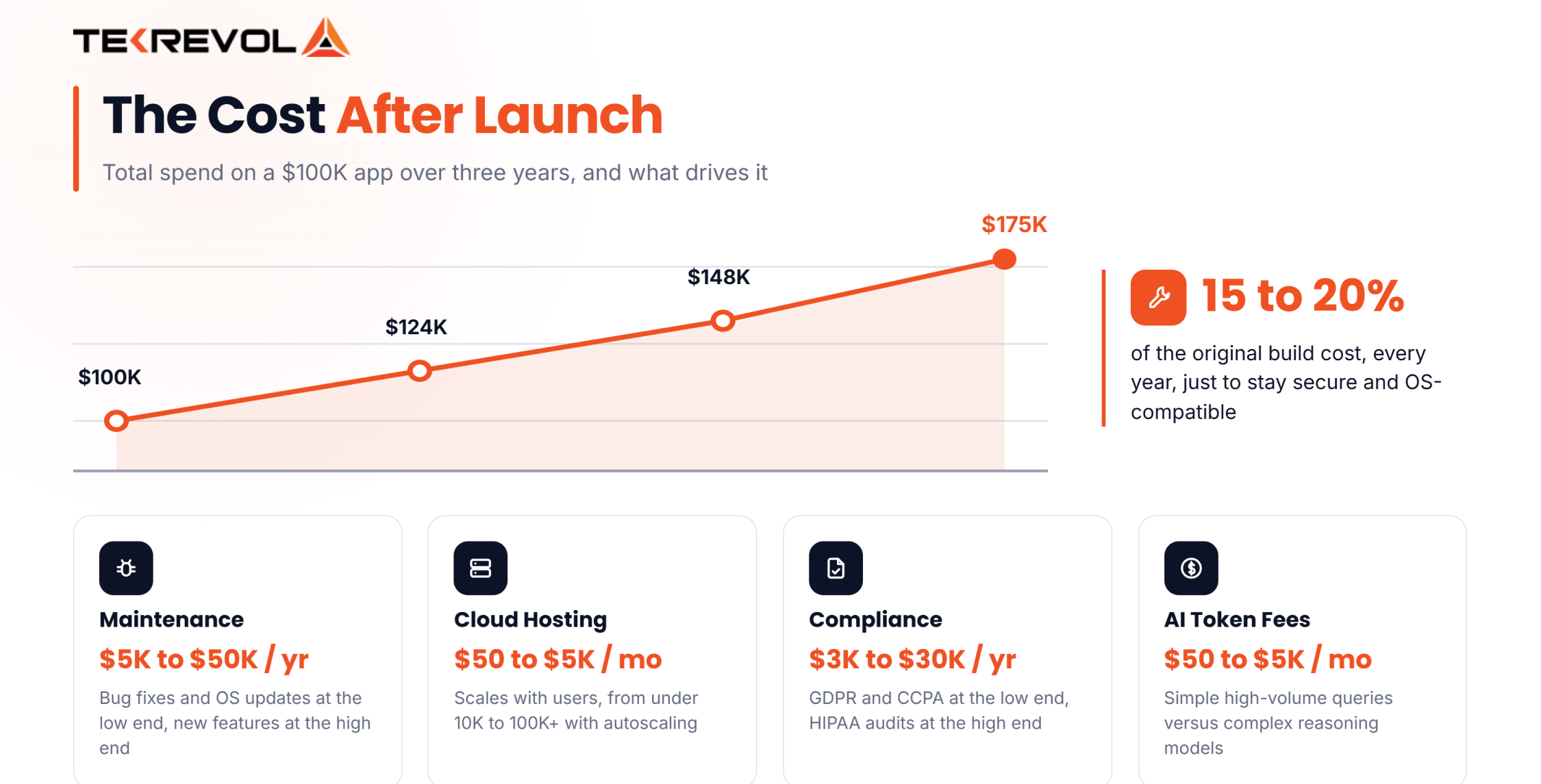
Most quotes end at launch. Budgets shouldn’t, and the gap between those two facts is where a lot of good products quietly die.
App Maintenance (15 to 20% Annually)
Maintenance isn’t only bug fixes; it’s keeping pace with Apple and Google’s evolving OS requirements. An app that goes unmaintained for consecutive OS cycles risks losing compatibility and visibility in search.
| Maintenance Tier | Scope of Work | Est. Annual Cost |
| Basic | Bug fixes, OS updates | $5,000 to $15,000 |
| Complex | Performance tuning, feature additions | $20,000 to $50,000 |
Infrastructure & Cloud Hosting
Hosting cost scales with your user base. Whether you use AWS, Azure, or GCP, this is a genuinely variable line item, not a fixed one.
| User Base | Hosting Needs | Est. Monthly Cost |
| Startup (under 10K users) | Shared or small instance | $50 to $300 |
| Scaleup (100K+ users) | Dedicated, autoscaling | $1,000 to $5,000+ |
Security Patches & Compliance
Cyber-compliance isn’t optional for apps handling personal or financial data. Ongoing security audits and certification maintenance are a recurring cost, not a one-time setup fee.
| Compliance Type | Focus Area | Est. Annual Cost |
| Data privacy | GDPR, CCPA | $3,000 to $12,000 |
| Healthcare | HIPAA audits | $10,000 to $30,000 |
AI Token & API Usage Fees
If your app runs on generative AI, you have a variable cost every month. Models charge based on token usage, so a viral spike in usage can spike your bill unexpectedly. Monitoring this in real time protects your margins.
| Model Tier | Typical Usage | Est. Monthly Cost |
| Lite (fast, high-volume chat) | High-volume, simple queries | $50 to $500 |
| Pro (complex reasoning) | Lower volume, higher complexity | $500 to $5,000+ |
Free Strategy and Maintenance Consultation
We'll show you how to plan your maintenance budget properly from day one, so hidden costs don't catch you off guard post-launch.
Talk to an Expert TodayStrategies to Optimize Your Mobile App Development Budget
You can cut app costs without wrecking the product by shipping an MVP first, choosing cross-platform, using managed backend services, and cutting features rather than corners. Together, those save 30% to 50%. What you can’t safely cut is QA, discovery, or backend architecture.Here’s how to apply that without cutting corners:
- Start with an MVP, not the full vision. Focus on the one core problem your app solves. Launch with 3 to 5 core features, gather real usage data, then expand.
- Use AI coding assistants deliberately. Tools like GitHub Copilot speed up boilerplate code, unit testing, and documentation, and that efficiency should show up in your quoted hours.
- Match your team model to your project stage. A freelancer for early validation, an agency for a production MVP, in-house once you have product-market fit and a long roadmap- that’s the hybrid pattern most successful launches actually use.
- Source regionally where it makes sense. A US-based product lead for strategy paired with a vetted offshore team for well-scoped execution balances cost and quality better than an all-or-nothing approach.
- Fund design and QA properly. Per the stage framework above, cutting either to protect the “coding” line item is the most common cause of budget overruns later, not a way to avoid them.
Why Choose TekRevol for Mobile App Development?
Calculating mobile app development cost is only half the work; execution is where it either pays off or doesn’t. At TekRevol, we’ve delivered 800+ successful projects across 11+ industries, with a team of 500+ professionals and a 4.8/5 rating on Clutch (verified reviews) and 5.0 on GoodFirms.
We provide transparent, data-driven cost breakdowns tailored to the US market’s standards, whether you need a HIPAA-compliant MedTech platform or a high-frequency fintech engine. Our team works across native iOS, Android, and cross-platform builds to match the right approach to your budget, not the other way around.
Ready To Become The Digital Titan In Your Niche?
Partner with TekRevol to transform your vision into a scalable digital product built for long-term growth and market leadership.
Let's Connect!