



- Mobile app development in Canada costs CAD 30,000 to 300,000+, with most projects landing between 60,000 and 150,000.
- Team location matters most; Toronto and Vancouver charge premium rates, while Halifax offers the lowest onshore hourly rates.
- Feature depth beats feature count: a simple login costs $500, but real-time chat can run up to $40,000.
- SR&ED now offers 35% refundable credits up to CAD 6 million, following Bill C-15’s expanded 2024 limits.
- Privacy compliance adds 10-35% to costs, with PIPEDA, Quebec’s Law 25, and FINTRAC carrying the heaviest obligations.
- Currency exposure is a hidden ongoing cost, since most infrastructure, like AWS and Stripe, bills in USD monthly.
- Ongoing maintenance costs 15-20% of the build cost annually, covering OS updates, security patches, and third-party API changes.
Canada has become one of North America’s fastest-growing hubs for mobile app development, with businesses from Toronto to Vancouver to Calgary investing heavily in custom apps to reach their customers.
But before any of that innovation happens, every business owner runs into the same question: how much is this actually going to cost? Prices vary widely, partly because of Canada’s provincial tax structure, since HST, GST, and PST rates differ by province and directly affect your final invoice.
On average, mobile app development in Canada costs between CAD 30,000 and 300,000 or more. A simple app with basic features runs CAD 30,000 to 55,000. An MVP with a real backend runs CAD 55,000 to 95,000. Mid-complexity apps with custom design and integrations land between 95,000 and 180,000, and regulated or enterprise builds start at 180,000 and climb past 300,000.
The final number comes down to who you hire. An experienced mobile app development company in Canada brings designers, developers, and project managers to the table. That shows up in agency rates of CAD 120 to 200 an hour in Toronto, Vancouver, and Montreal.
In this blog, we’ll let you know exactly what shapes each price range, so you can budget your app project with confidence.
How Much Does Mobile App Development Cost in Canada in 2026?
Mobile app development cost in Canada ranges from CAD 30,000 for a simple app to CAD 300,000 or more for an enterprise or regulated build. Most Canadian projects land between CAD 60,000 and 150,000, depending on complexity and privacy obligations.
Here’s how the tiers break down.
| Tier | Cost (CAD) | Timeline | What you actually get |
| Simple app | $30,000 to $55,000 | 6 to 10 weeks | One platform, 6 to 10 screens, light backend, standard design |
| MVP | $55,000 to $95,000 | 3 to 4 months | Cross-platform, core features, basic backend, one or two integrations |
| Mid-complexity business app | $95,000 to $180,000 | 4 to 8 months | Custom design, admin dashboard, payments, several integrations |
| Complex or regulated app | $180,000 to $300,000+ | 8 to 14 months | Multi-role access, deep integrations, audit trails, compliance review |
Note: Canadian agencies quote excluding sales tax, so add your provincial rate when comparing against an all-in figure. And these are sticker prices. The next section explains why your real cost is usually lower.
Planning your app budget?
Our experts will review your existing technology stack, workflows, and business goals to identify the highest-ROI AI integration opportunities with a practical implementation plan.
Schedule Your Free ConsultationFactors That Affect Mobile App Development Cost in Canada
Mobile app development cost factors in Canada are team location, feature depth, platform strategy, integration count, design ambition, bilingual requirements, data residency, and emerging tech. Team location and feature depth drive most of the gap between two competing Canadian quotes.
1. Team location
Where your team sits changes your hourly rate more than almost any other factor. Toronto and Vancouver sit at the top; Montreal and Ottawa offer strong talent at lower rates, and smaller markets keep costs down while staying onshore.
| City | Hourly Rate (CAD) | Specialty |
| Toronto | $110 to $170 | Largest senior-dev pool, fintech bench |
| Vancouver | $105 to $165 | Cloud, mobile, gaming |
| Montreal | $90 to $140 | AI/engineering, French capability built in |
| Ottawa | $95 to $145 | Gov-adjacent, procurement experience |
| Calgary | $90 to $135 | Energy and logistics specialization |
| Halifax & Atlantic Canada | $70 to $115 | Lowest onshore rates, growing SMB market |
2. Feature Depth
A wishlist with fifteen items tells a vendor nothing. Login and real-time tracking both count as “one feature” and differ by CAD 50,000. Here’s what the most common features actually cost to build, based on Canadian dev rates.
| Feature | Cost (CAD) | Why it costs what it costs |
| Basic login (email/password) | $2,000 – $5,000 | Simple form, minimal backend logic |
| Social login (Google/Apple/Facebook) | $4,000 – $9,000 | OAuth setup across multiple providers |
| Push notifications | $3,000 – $7,000 | Firebase setup plus segmentation and timing logic |
| Maps and GPS/location | $4,000 – $12,000 | API integration, real-time location handling |
| Analytics integration | $6,000 – $18,000 | Event tracking, dashboard setup |
| Cloud storage and backend infrastructure | $8,000 – $25,000 | Server setup, database architecture |
| Payment gateway (Interac, Moneris, Stripe) | $8,000 – $25,000 | Encryption, compliance, transaction testing |
| Real-time chat/messaging | $12,000 – $40,000 | Functions like a mini social network under the hood |
| Admin dashboard | $10,000 – $25,000 | Rarely seen by users, does most of the operational heavy lifting |
| Advanced security (biometrics, compliance) | $15,000 – $50,000 | Encryption layers, audits, regulatory sign-off |
| IoT/device integration | $20,000 – $60,000 | Bluetooth, sensors, device pairing |
| AI/ML features (recommendations, chatbots) | $20,000 – $60,000+ | Model training, data pipeline, ongoing tuning |
| AR/VR features | $25,000 – $80,000 | 3D rendering, spatial mapping |
3. Platform Choice
Cross-platform development costs the least for most Canadian apps, delivering both platforms for roughly 10% to 30% above a single native build. Two separate native builds cost 70% to 90% more.
| Approach | Estimated cost (CAD) | Timeline | Best suited to |
| iOS only | $35,000 – $120,000 | 3–5 months | Canadian consumer apps, since local users skew Apple |
| Android only | $35,000 – $110,000 | 3–5 months | Field teams, logistics, and audiences beyond Canada |
| Cross-platform (Flutter/React Native) | $40,000 – $130,000 | 4–6 months | Most Canadian business apps need both platforms |
| Two native builds | $70,000 – $220,000 | 6–10 months | Device-heavy features or performance-critical apps |
| Hybrid or PWA | $18,000 – $60,000 | 6–12 weeks | Content-led products and internal tools |
The bigger cost gap appears in year two. A second native platform means building every new feature and fixing every issue twice, while cross-platform app development services let you maintain one codebase. Two native codebases can cost 60%–80% more to maintain annually than one cross-platform codebase serving the same users.
4. Integration Count
Each third-party connection adds its own build cost. It also adds a testing surface that grows with every other integration already in the app. Five working independently is manageable. Five that all touch the same user record mean every one can break the other four.
| Integration type | Cost (CAD) | Why it costs what it costs |
| CRM sync (HubSpot, Salesforce) | $4,000 – $12,000 | Field mapping, sync conflicts, rate limits |
| Calendar sync (Google/Outlook) | $5,000 – $12,000 | Two-way sync, double-booking logic |
| SMS/email provider (Twilio, SendGrid) | $2,000 – $6,000 | Delivery tracking, template management |
| Banking/identity API (Plaid, Flinks) | $10,000 – $30,000 | KYC handling, error states, compliance logging |
| E-commerce platform sync (Shopify) | $6,000 – $18,000 | Inventory sync, webhook reliability |
| ERP or inventory system | $12,000 – $35,000 | Legacy system quirks, custom field mapping |
The vendor question worth asking isn’t “How much does this integration cost?” It’s “what happens to the other four when this one changes its API.” That’s the cost that shows up in year two, not in the quote. If your build leans heavily on customer data, our CRM development services team covers the sync layer in more depth.
5. Design Ambition
Template-based UI and a fully custom design system can carry the same feature list and land CAD 40,000 apart. The gap isn’t the Figma file. It’s that every piece of custom interaction has to be hand-built in code rather than pulled from a component library.
| Design tier | Cost (CAD) | What you get |
| Template/UI-kit based | $5,000 – $15,000 | Fast, functional, looks like other apps in your category |
| Custom design system | $15,000 – $35,000 | Branded components, consistent visual language, reusable |
| Custom motion and interaction | $10,000 – $30,000 (on top) | Bespoke transitions, gesture-based flows |
| Full brand identity build | $20,000 – $50,000 | Logo, design system, and app built together from scratch |
A custom design system is one of the few line items that pays for itself: it’s a one-time cost that makes every feature you build after launch faster and cheaper to design, because the components already exist.
6. Bilingual Requirements
This is more than translation. French text typically runs 15% to 20% longer than the English equivalent. So, UI built and tested only in English breaks the moment French copy goes in. Truncated labels, overlapping buttons, broken layouts. Budgeting translation without budgeting a layout pass is the most common miss here.
| Requirement | Cost (CAD) | Why |
| Basic content translation | $3,000 – $8,000 | Static UI strings, legal pages |
| Full bilingual content pipeline | $8,000 – $20,000 | CMS support for parallel content, ongoing translation workflow |
| Layout QA for French text expansion | $4,000 – $10,000 | Re-testing every screen against longer strings |
| AODA/WCAG accessibility on top | $6,000 – $22,000 | Screen reader support, contrast, keyboard navigation |
If any part of your user base is in Quebec, or you’re federally regulated, this isn’t a nice-to-have; it’s the Charter of the French Language. Building it in from the design phase costs a fraction of retrofitting it after the English-only version ships.
7. Data Residency
Where the data physically sits and who legally controls it are two different questions. Canadian teams increasingly have to answer both. Hosting in a Canadian AWS region satisfies residency. It doesn’t satisfy sovereignty if a US parent company still holds the encryption keys, because the US CLOUD Act can compel access wherever the servers sit.
| Hosting approach | Cost (CAD) | Why |
| Standard Canadian-region hosting | Included in base infra | Satisfies data residency only |
| Residency + BYOK/HYOK architecture | $10,000 – $30,000 | Customer-controlled encryption keys satisfy sovereignty |
| Multi-region setup (Canada + US expansion) | $15,000 – $40,000 | Separate data pools per jurisdiction |
| Full data sovereignty audit | $8,000 – $20,000 | Legal + technical review of where control actually sits |
For healthcare, finance, or government-adjacent apps, this is often the most expensive line item nobody budgets for at the scoping stage.
8. Trending & Emerging Tech Features
AI, AR, and VR carry a premium beyond their raw build hours. The talent pool is smaller, and the tooling changes fast. “Done” also isn’t really done, since models and rendering engines need tuning long after launch.
| Feature | Cost (CAD) | Why it costs what it costs |
| AI chatbot/support assistant | $15,000 – $40,000 | Prompt design, integration with support data, ongoing tuning |
| AI recommendations/personalization | $20,000 – $60,000+ | Data pipeline, model training, continuous retraining as behavior shifts |
| Generative AI content features | $25,000 – $70,000+ | API costs scale with usage, output moderation, and quality control |
| AR try-on/visualization | $30,000 – $80,000 | 3D asset creation, spatial mapping, device performance tuning |
| VR/immersive experience | $40,000 – $120,000+ | Full 3D environment build, performance optimization per headset |
| Voice interface/assistant integration | $12,000 – $35,000 | Speech recognition accuracy, multi-accent handling, fallback logic |
One thing worth knowing for Canadian companies: AI feature work is often the strongest SR&ED candidate in a build, because technical uncertainty is easier to demonstrate there. Our AI development company models running costs before quoting, so the operating line never arrives as a surprise.
How Much Does It Cost to Build an iPhone App in Canada from Scratch?
Building an iPhone app in Canada from scratch costs CAD 35,000 to 120,000 for most business apps. Regulated or feature-heavy iOS builds run 120,000 to 200,000 or more. Apple’s review standards and design expectations push polish costs higher than Android’s.
iOS is where most Canadian consumer apps start, and there’s a good reason for it. Canadian users skew further toward Apple than most global markets, and iOS users spend more per head on in-app purchases and subscriptions. If your model is a subscription, that matters more than raw install numbers.
Here’s what moves the number on an iOS build specifically.
- Apple’s Human Interface Guidelines set a higher polish bar: Design that would ship fine on Android gets flagged on iOS, and rework costs real days.
- App Store review is a scheduling risk: First-submission rejections are common, usually over privacy labels, account deletion, or subscription wording.
- Device range is narrow, which helps: Testing across a dozen iPhone and iPad models is far less work than covering the Android ecosystem.
- Swift talent is well paid in Canada: Senior iOS specialists in Toronto and Vancouver sit at the top of the local rate band.
Any experienced iOS app development company in Canada should be able to work within that range and should tell you which features push you past it before you sign.
Our detailed cost to develop an iOS app breakdown goes feature by feature if you want the granular version.
How Much Does It Cost to Build an Android App in Canada from Scratch?
Building an Android app in Canada from scratch costs CAD 35,000 to 110,000 for most business apps, rising past 110,000 for complex or regulated builds. Android costs slightly less to design and slightly more to test, so the totals land close to iOS.
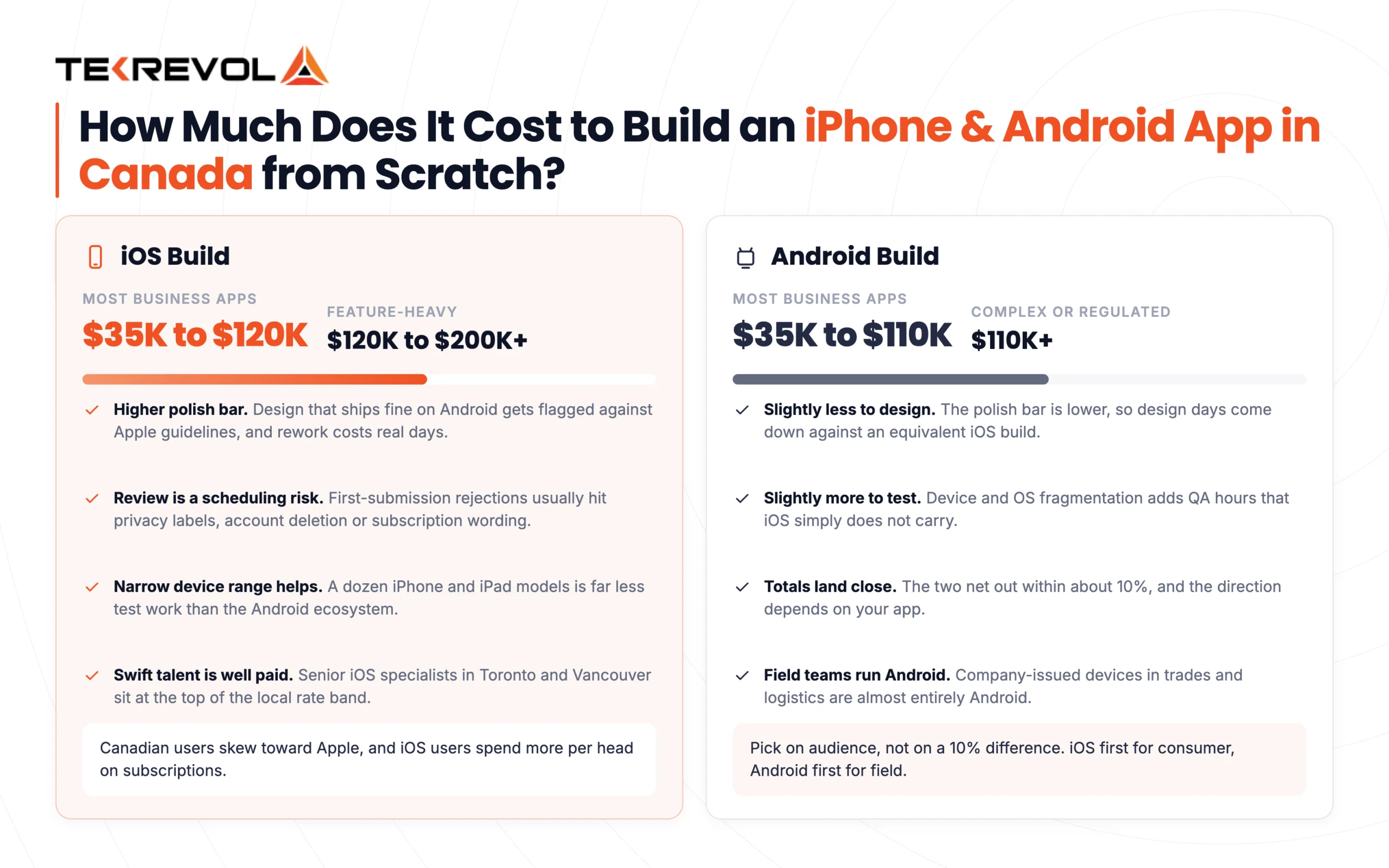
You’ll read that Android is meaningfully cheaper than iOS. On the like-for-like scope, that isn’t what we see. The two land within roughly 10% of each other, and the direction depends on your app.
| Where the cost sits | iOS | Android |
| Design and polish | Higher, guidelines are stricter | Lower, Material Design is more forgiving |
| Store review | Slower, rejection more common | Faster, more automated |
| Device and OS testing | Lower, narrow device range | Higher, a wide range of makers and screen sizes |
| Developer account | CAD $136/year | CAD $34 one-time |
| Fragmentation risk | Minimal | Real, and it grows with your user base |
So pick on the audience, not on a 10% difference. In Canada, that usually means iOS first for consumer apps and Android first for field, trade, and logistics teams, where company-issued devices run almost entirely on Android. Our Android app development company scopes both paths side by side.
If you want the underlying market data, our comparison of Android and iOS usage patterns breaks the split down by region and by revenue per user.
Mobile App Development Cost in Canada by App Type
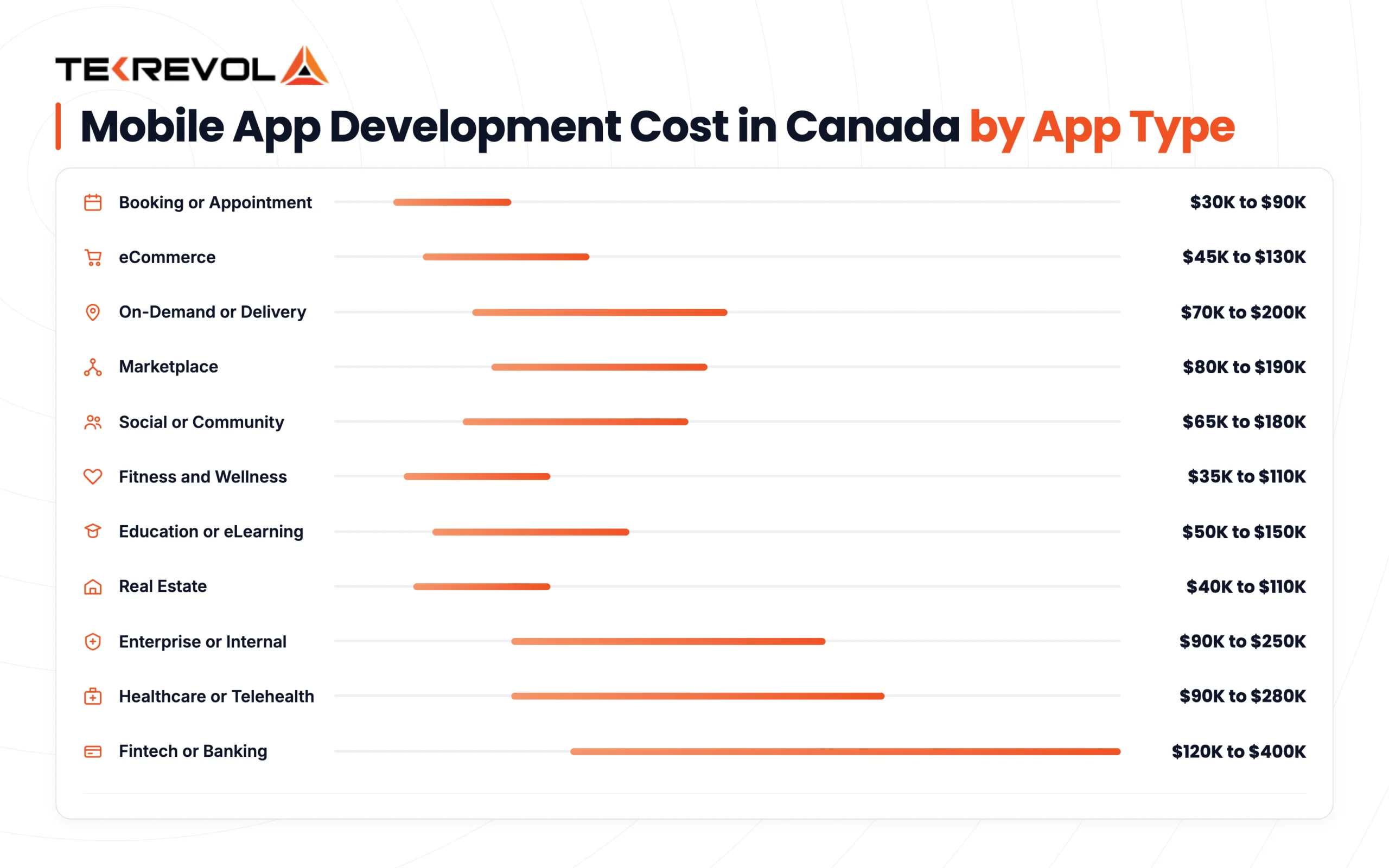
App development costs by type in Canada range from CAD 30,000 for a simple booking app to CAD 400,000 for a regulated fintech platform. Compliance obligations and integration depth drive that spread far more than how many screens you’re building.
Booking or Appointment App
Cost: $30,000 – $90,000 CAD
The booking screen is relatively simple. The real cost comes from calendar sync, double-booking prevention, rescheduling, and automated reminders. Without these, the app may look polished but fail when bookings overlap or schedules change.
MoCuts Pro shows where the money actually goes here. It’s a booking marketplace, and the calendar was the cheap part. Live GPS tracking, in-app messaging, provider verification, and wallet payouts turned it into a two-sided platform, and each carried its own line item.
eCommerce App
Cost: $45,000 – $130,000 CAD
The cost of an eCommerce app depends heavily on catalog size, product variations, checkout, payment processing, inventory, and order management. Adding features such as personalized recommendations, loyalty programs, multiple sellers, or real-time inventory can push the budget higher.
That’s why our eCommerce app development services team always starts with the payments layer rather than the storefront.
On-Demand or Delivery App
Cost: $70,000 – $200,000 CAD
This is really two apps: one for customers, one for drivers, plus live GPS tracking tying them together in real time. Think Uber Eats or SkipTheDishes: the driver-side app is often underestimated in early quotes because it’s invisible to the end customer, but it’s roughly half the engineering effort.
Marketplace App
Cost: $80,000 – $190,000 CAD
Marketplace apps cost more because they support multiple user types, seller profiles, product listings, payments, order management, and admin controls. Features such as commissions, refunds, reviews, disputes, and seller payouts add another layer of complexity and can quickly increase the development budget.
Social or Community App
Cost: $65,000 – $180,000 CAD
Moderation isn’t a policy document; it’s engineering: content filtering, reporting flows, and admin tooling to act on reports fast. Underbuilding is how community apps become unusable within months of launch. Our breakdown of social media app development costs goes deeper into that category.
Fitness and Wellness App
Cost: $35,000 – $110,000 CAD
A basic fitness app can stay within this range with workout plans, progress tracking, activity logs, and reminders. Costs increase when you add wearable and health-data integrations, personalized plans, nutrition tracking, video content, or real-time features. Each added integration also brings more testing and ongoing maintenance.
Education or eLearning App
Cost: $50,000 – $150,000 CAD
The cost depends on how much learning functionality the app needs. Video lessons, course management, quizzes, progress tracking, assessments, certificates, student accounts, and instructor dashboards can all add to the development budget. Live classes, subscriptions, and personalized learning features can push costs higher.
Real Estate App
Cost: $40,000 – $110,000 CAD
Property apps can become expensive when they need live listing data. MLS integrations, data licensing, frequent updates, location-based search, maps, and listing management all add development work. The more regions and data sources the app supports, the higher the overall cost.
Healthcare or Telehealth App
Cost: $90,000 – $280,000 CAD
The cost of building a healthcare app depends on its features, integrations, and compliance requirements. Basic apps with appointment booking, patient profiles, secure messaging, and reminders cost less, while telehealth features such as video consultations, electronic health record integration, prescriptions, payments, and remote monitoring can significantly increase the budget.
Fintech or Banking App
Cost: $120,000 – $400,000 CAD
The cost of building a fintech or banking app depends on the level of financial functionality and security required. Basic features such as account management, payments, transaction history, and notifications are relatively straightforward.
Adding KYC, fraud detection, banking integrations, money transfers, investment tools, and real-time transaction processing can significantly increase the development cost. Our piece on fintech’s influence on Canadian app development covers the local market context.
Enterprise or Internal App
Cost: $90,000 – $250,000 CAD
Enterprise apps typically require multiple user roles, complex workflows, business integrations, reporting, and advanced security. The more processes the app needs to support and the more existing systems it needs to connect with, the higher the development cost.
Mobile App Development Cost Breakdown by Phase
App development costs are split across five phases: discovery, design, development, testing, and launch. Development eats the biggest share, roughly half your budget, which catches most first-time buyers off guard when they see the full breakdown laid out.
Discovery and Scoping (10–15% of budget)
Estimated Cost: CAD 12,000 to 18,000 on a 120,000 build | Timeline: 1 to 3 weeks
This phase is where requirements get locked, architecture gets planned, and a real costed roadmap gets built instead of a guess. It’s also the phase founders try to skip to save time, which almost always backfires. Vague scope going into development is the single most reliable predictor of a blown budget.
UI/UX Design (15–25% of budget)
Estimated Cost: CAD 18,000 to 30,000 on a 120,000 build | Timeline: 3 to 6 weeks
Design decisions made early are cheaper to change than code already in development. Wireframes and a design system help identify issues before they turn into costly development changes.
- Wireframes and user flow mapping
- Full design system (components, typography, colour)
- Interactive prototype and user testing
Development (40–55% of budget)
Cost: CAD 48,000 to 66,000 on a 120,000 build | Timeline: 8 to 20 weeks
This is where the actual product gets built: frontend, backend, and every integration you scoped in phase one. It’s the biggest line item because it’s the longest phase and the one where complexity compounds fastest, especially once real-time features or third-party APIs enter the picture.
| Complexity | Typical dev hours |
| Basic | 500–600 hrs |
| Mid-complexity | 900–1,200 hrs |
| Advanced | 2,000+ hrs |
Testing and QA (15–20% of budget)
Cost: CAD 18,000 to 24,000 on a 120,000 build | Timeline: 2 to 4 weeks
Skipping proper QA doesn’t save money; it just moves the cost to after launch, where fixes cost more and users notice. This phase covers device compatibility, security testing, and real user acceptance testing before anything ships.
- Cross-device and cross-OS testing
- Security and penetration testing
- User acceptance testing (UAT)
Launch and Deployment (5–10% of budget)
Cost: CAD 6,000 to 12,000 on a 120,000 build | Timeline: 1 to 2 weeks
The smallest phase by cost, but the one that determines whether your app actually reaches users cleanly. App store submission alone can add days to your timeline if your listing or metadata gets flagged on first review.
- App Store and Google Play submission
- Post-launch monitoring setup
- Handover documentation and training
What Are App Development Hourly Rates in Canada?
App development hourly rates in Canada run CAD 120 to 200 for agencies, CAD 80 to 130 for mid-level developers, and CAD 40 to 100 for freelancers. Local salaries, payroll taxes, benefits, and senior talent demand all push these rates up.
| Engagement type | Rate (CAD/hr) | What you’re really paying for |
| Enterprise agency | $160 to $300 | Multi-team delivery, formal process, procurement-friendly contracts |
| Boutique Canadian agency | $120 to $200 | Local timezone, accountability, senior attention |
| Mid-level Canadian developer | $80 to $130 | Capable delivery, less architectural depth |
| Canadian freelancer | $40 to $100 | Lowest local cost, no redundancy if they disappear |
| Hybrid (Canadian lead, offshore build) | $60 to $110 blended | Local ownership at a lower blended rate |
| Offshore team | $30 to $70 | Widest quality spread, so vendor selection matters most |
App Development Costs by Hiring Model in Canada
Hire a Canadian agency for regulated or stakeholder-heavy builds, a freelancer for isolated features, and an offshore team for well-defined scopes you can manage remotely. Most Canadian scale-ups end up hybrid, keeping product and compliance onshore.
Canadian agency: $120,000 to $280,000 CAD
You’re paying for proximity and accountability, plus a team that already understands PIPEDA, Interac, and provincial compliance without a learning curve. Right call when your app touches regulated data or has enough stakeholders that miscommunication gets expensive fast.
Offshore agency: $45,000 to $120,000 CAD
The lowest headline price and a real saving only if your scope is genuinely locked before work starts. Timezone gaps and communication overhead eat into that discount fast on anything ambiguous.
Hybrid: $70,000 to $180,000 CAD
Where most Canadian scale-ups land after their first build: an onshore technical lead directing an offshore or nearshore execution team. This model works only when the onshore owner is strong enough to identify problems early, maintain technical standards, and prevent small issues from compounding into expensive rework later.
Freelancers: $25,000 to $80,000 CAD
Cheapest option, and right for isolated features, design work, or a prototype. The risk is continuity. Nobody owns the architecture, and one freelancer getting pulled onto another project can stall you cold. Our comparison of agency versus freelancer delivery sets out where each genuinely wins.
In-house team: $450,000 to $800,000 a year CAD
Makes sense only when the app is your permanent core product, not a one-off project. Highest fixed cost, but full control and no handoff risk when priorities shift.
One cost trap gets overlooked: Check the currency before comparing development quotes. A US$75,000 offshore estimate is about CAD $101,000, leaving only a small difference from a CAD $110,000 local quote.
Before comparing vendors, normalize every quote to CAD, excluding sales tax, with payment milestones clearly stated. If you already have engineers but need mobile expertise, IT staff augmentation can be a more flexible option than a fully outsourced build.
What Do You Actually Pay After SR&ED and Provincial Credits?
Canadian companies can recover up to 35% of eligible app development spend through SR&ED, plus a provincial top-up. On a CAD 120,000 build with strong eligibility, the effective cost often falls closer to CAD 84,000, which changes vendor comparisons entirely.
Use the current SR&ED rates when estimating your potential benefit, rather than relying on figures from previous years.
What changed
Bill C-15 expanded SR&ED for tax years starting on or after December 16, 2024:
| Rule | Old | Current |
| Enhanced expenditure limit (CCPCs) | $3M | $6M |
| Max refundable credit at 35% | $1.05M | $2.1M |
| Capital phase-out range | $10M–50M | $15M–$75M |
| Public corporations | 15% non-refundable only | Now eligible for 35% |
| Capital expenditures | Not eligible | Eligible again |
Canadian Privacy Compliance: Costs to Budget For
Canadian privacy compliance adds 10% to 35% to app development cost, depending on the data you hold and where your users live. PIPEDA sets the federal floor. Quebec’s Law 25 is stricter, and it applies as soon as you have Quebec users. Here’s what actually applies today:
| Rule | Applies to | What it adds (CAD) |
| PIPEDA | Any private-sector organization handling personal data across a province or border | $6,000 – $20,000 for consent flows, policy, retention rules |
| Quebec Law 25 | Any app with Quebec users, regardless of where you’re based | $8,000 – $25,000, including data portability |
| PHIPA (Ontario) / HIA (Alberta) | Health information custodians and their service providers | $15,000 – $60,000 for audit trails and review workflow |
| AODA (Ontario) | Ontario organizations with 50+ employees, public-facing content, enacted to remove barriers for persons with disabilities | $6,000 – $22,000 to reach WCAG 2.0 AA |
| FINTRAC | Money services and certain payment products | $20,000 – $70,000 for identity verification and reporting |
Why Quebec gets its own line: Law 25 brings stricter privacy rules, including consent, privacy by default, breach reporting, and data portability. Developers may need to build extra features for users to access and export their data.
Know your compliance requirements before development starts
We’ll review how your app collects, stores, and uses data and help you identify the controls that should be part of the build
Request a Data Assessment!Which Canadian Grants and Tax Credits Can You Stack?
Canadian companies can stack SR&ED with provincial credits and, separately, IRAP funding. Ontario adds up to 8% through OITC, British Columbia roughly 10%, and OIDMTC returns up to 40% on eligible interactive media labour for qualifying products.
SR&ED is the headline. Here’s what sits alongside it.
| Program | Whois its for | What it returns |
| SR&ED (federal) | CCPCs and now eligible Canadian public corporations | 35% refundable on the first $6M of eligible spend |
| Ontario OITC | Ontario CCPCs | Roughly 8% on top of SR&ED |
| Ontario ORDTC | Ontario corporations | Roughly 3.5% non-refundable |
| BC SR&ED credit | BC corporations | Roughly 10% provincial top-up |
| OIDMTC (Ontario) | Interactive digital media products | Up to 40% refundable on eligible labour and marketing |
| BC IDMTC | Interactive Digital Media | 25% refundable |
| Alberta IEG | Alberta’s small and medium businesses | Up to 20% on R&D spend |
| Nova Scotia DMTC | Nova Scotia digital media | 50–60% refundable on eligible salaries |
| NRC IRAP | Technical projects with innovation content | 50–80% of technical salaries, non-repayable |
There are two important distinctions. IRAP provides funding rather than a tax credit, so approval needs to come before spending. OIDMTC also isn’t available to every app, as the product must meet its interactive digital media eligibility requirements.
Rates are based on 2026 figures published by the relevant federal and provincial authorities. Confirm current rates and eligibility before budgeting.
Hidden and Ongoing Mobile App Development Costs
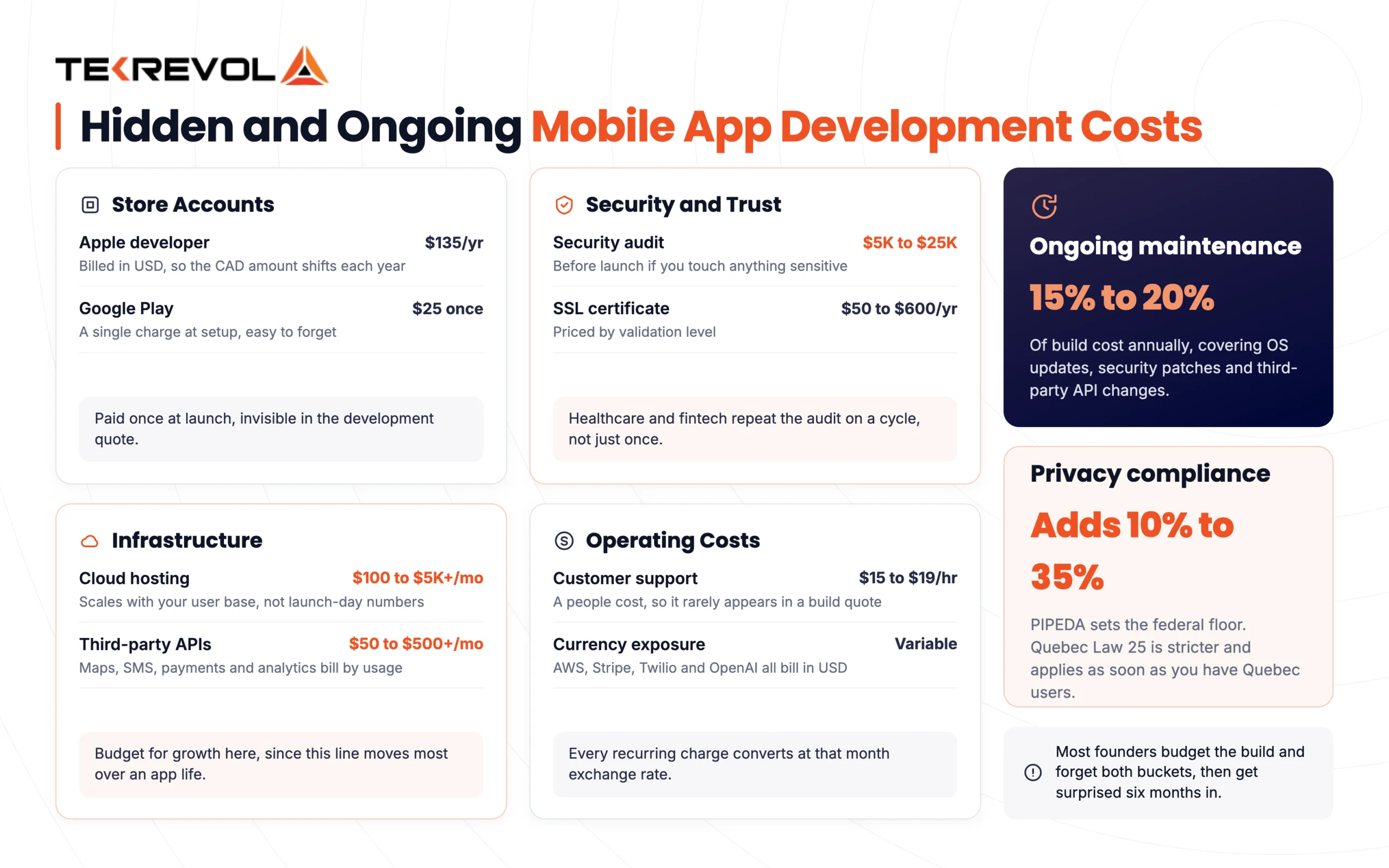
Hidden app costs fall into two buckets: one-time costs you pay at launch, and recurring costs that hit every month for as long as the app exists. Most founders budget the build and forget both, then get surprised six months post-launch.
App Store and Developer Accounts
Cost: $135 CAD/year (Apple) + $25 CAD one-time (Google)
Apple charges an annual developer fee, billed in USD, so the CAD amount shifts slightly year to year with the exchange rate. Google’s fee is a single one-time charge. Small numbers on their own, but easy to forget at renewal since they don’t show up anywhere in your original development quote.
SSL Certificate and Security Audit
Cost: $50 – $600/year (SSL) + $5,000 – $25,000 (initial audit)
Every app handling user data needs an SSL certificate, priced by validation level, plus a security audit before launch if you’re touching anything sensitive. This is a one-time cost at launch, but regulated industries (healthcare, fintech) need to repeat it on a cycle, not just once.
Cloud Hosting
Cost: $100 – $5,000+/month
Hosting scales directly with your user base, so this number moves the most over an app’s life. A basic app with a few thousand users sits at the low end; anything with real-time features or heavy media storage climbs fast. Budget for growth here, not your launch-day numbers.
Third-Party APIs
Cost: $50 – $500+/month
Maps, SMS, payment processing, and analytics tools all bill separately from your core hosting, and their usage-based costs grow with adoption.
Ongoing Maintenance
Cost: 15–20% of build cost, annually
This covers bug fixes, OS compatibility updates, and general upkeep to keep the app functional as Apple and Google push updates. Putting off maintenance only shifts the cost into the future. As the app ages, outdated dependencies and platforms can turn small fixes into expensive problems.
Feature Additions Post-Launch
Cost: Varies by scope
Real users will ask for things your original scope didn’t include. Smart founders build a small post-launch budget into year one instead of treating every new feature request as a surprise expense.
Customer Support Staffing
Cost: $15 – $19/hour
Someone needs to handle user questions and bug reports once real people are using the app. Often overlooked because it’s a people cost, not a development cost, but it’s real, and it’s ongoing.
Currency Exposure
Cost: Variable, tied to CAD/USD exchange rate
Most of the infrastructure a Canadian app runs on, AWS, Stripe, Twilio, OpenAI- bills in USD. Every recurring charge above converts at whatever the exchange rate happens to be that month, so your hosting and API costs move with currency swings on top of usage growth. For Canadian businesses, US-denominated infrastructure can create an ongoing cost as exchange rates affect monthly bills.
Mobile App Development Cost Examples by Industry
Building a SkipTheDishes-style delivery app costs CAD 150,000 to 350,000. A Wealthsimple-style investing app costs CAD 200,000 to 500,000. These estimate comparableto first-release functionality, not what those companies have spent since.
Their actual budgets aren’t public. The useful comparison is what similar functionality would cost to build in Canada today.
| App | Comparable build cost (CAD) | The hardest part to replicate |
| SkipTheDishes | $150,000 to $350,000 | Three-sided logistics: customer, restaurant, courier |
| Wealthsimple | $200,000 to $500,000 | Regulatory licensing and identity verification |
| Shopify (merchant app) | $120,000 to $300,000 | Catalogue sync and payment reliability at scale |
| Hopper | $130,000 to $320,000 | Price prediction models and airline data feeds |
| Lightspeed (POS companion) | $110,000 to $260,000 | Offline resilience and hardware integration |
| Ritual | $90,000 to $220,000 | Merchant onboarding density in each neighbourhood |
The expensive part is rarely the feature users see. It’s the licence, the regulation, the integration, or the backend complexity behind it.
How Can You Reduce Mobile App Development Costs in Canada?
You can reduce Canadian app development costs by 30% to 50% through tight MVP scoping, cross-platform development, hybrid team models, and phased integrations. Claiming SR&ED where eligible is the largest single lever available on its own.
Scope a Genuine MVP
Three features that prove your value beat fifteen that dilute it. Founders who cut ruthlessly here typically save 40% off the first-release cost, and they learn what to build next from real users instead of guessing.
Go Cross-Platform
Building one codebase in React Native or Flutter instead of two separate native apps runs roughly 30% cheaper for equivalent functionality. You lose a small amount of raw performance and day-one access to brand-new OS features, but for most business apps, that trade-off is invisible to users and very visible on the invoice.
Use a Hybrid Team Model
A hybrid team can offer a practical balance between cost and control. An onshore technical lead manages quality, communication, and compliance, while an offshore team handles development work at a lower rate. The model depends on strong technical oversight.
Claim SR&ED, and Document as You Go
SR&ED can significantly reduce the net cost of eligible app development. Canadian-controlled private corporations may qualify for a federal credit of up to 35%, with additional provincial incentives in some cases. Proper documentation and tracking of eligible work throughout development are essential.
Check Whether You Need an App at All
A responsive web app costs 40% to 60% less than a native build, and for a lot of businesses, it does the job just as well. If your product doesn’t depend on push notifications, camera access, or offline use, a web app gets you to market faster and cheaper, with the option to go native later once you’ve proven demand.
Phase Your Integrations
Launch with read-only access and add write access once you’ve confirmed people actually want it. Building full read/write integrations upfront means paying for capability you may never use, especially on features where you’re not yet sure of real usage patterns.
What Does App Maintenance Cost Each Year in Canada?
App maintenance in Canada costs 15% to 25% of your build cost annually, so roughly CAD 18,000 to 30,000 on a CAD 120,000 app. That covers OS updates, bug fixes, security patches, third-party API changes, and small improvements.
Apple and Google ship major OS releases every year, and each one can break something. That alone makes maintenance structural rather than optional.
What the annual budget covers:
- OS compatibility updates: new iOS and Android releases, plus new device sizes
- Security patches and dependency updates: libraries go stale constantly
- Third-party API changes: your payment or mapping provider changes things without asking
- Bug fixes driven by real usage: the ones your test plan never predicted
- Small feature improvements: the ones users actually request
- Infrastructure scaling: as your user base grows
Skip a year,r and you don’t save 25%. You accumulate a rebuild. Our app support and maintenance team picks up apps built elsewhere as often as our own. Catching up almost always costs more than staying current would have.
How Do Canadian Apps Make Money?
Canadian apps monetize through subscriptions, in-app purchases, transaction commissions, advertising, freemium upgrades, and B2B licensing. Subscriptions dominate because Apple and Google both drop their commission from 30% to 15% once a subscriber passes their first year.
Cost only means something next to return, so here’s the other side of the ledger.
| Model | Best for | Note |
| Subscriptions | Consumer apps used regularly | Most predictable revenue; the year-one commission drop helps materially |
| In-app purchases | Games, content, feature unlocks | Works best when users see clear, immediate value in a specific item |
| Transaction commission | Marketplaces, on-demand apps | Typically 10–25%, depending on category |
| Advertising | High-frequency, high-volume apps | Needs real scale — Canadian CPMs are healthy, but the audience is small |
| Freemium | Apps with viral or broad appeal | Widest funnel; conversion rate decides everything |
| B2B licensing | Enterprise and vertical software | Highest contract values, longest sales cycles |
Canada has a large consumer market, but its size still matters when you’re building a business around scale. A 1% reach means about 410,000 users, which can support subscriptions but may be limiting for ad-based models. If US expansion is part of the plan, it should be considered in the product architecture and budget from the start.
Partner With TekRevol for Mobile App Development in Canada
At TekRevol, we help Canadian businesses build mobile apps that are fast, secure, and built for real users. Whether you are a startup launching your first product or an enterprise looking to scale, our team brings the experience and technical depth to deliver mobile solutions that work in the Canadian market.
With 10+ years of experience, 500+ successful app projects, and ISO certification, we take your app from idea to launch, managing development, testing, deployment, and compliance while keeping the project on track and within the agreed budget.
Whether you are in Toronto, Vancouver, Montreal, or Calgary, our team will walk you through exactly what your project would cost, where the real risks sit, and what approach, native or web, actually makes sense for your goals.
- Custom mobile apps built for iOS, Android, or both, designed around your specific business goals and user needs
- End-to-end development from strategy and UI/UX design to development, testing, and post-launch support
- Secure and compliant solutions built to meet Canadian data privacy standards and industry regulations
- Dedicated team with hands-on experience across healthcare, finance, retail, and more — matched to your project from day one
Ready to Take Your App Idea Further?
Get expert guidance on product strategy, technology, UX, and development to move from concept to launch.
Talk to Our Team!


