



- SaaS app development cost in 2026 runs from $18,000 for a lean MVP to $450,000-plus for enterprise platforms.
- Engineering eats roughly half your budget, while design, QA, and discovery split most of the rest.
- Multi-tenancy, integrations, and compliance drive price harder than the raw number of screens you want.
- Post-launch costs land near 15 to 25 percent of your build budget every single year after launch.
- AI features and usage-based vendor pricing are the fastest-growing surprise line items in SaaS budgets right now.
- Cutting scope protects your product, while cutting engineering rates or QA usually costs more within eighteen months.
Your SaaS budget rarely gets wrecked by one expensive feature. It gets wrecked by building too much, too early, enterprise-grade permissions, complex billing, dozens of integrations, and infrastructure for users you haven’t acquired yet. The smartest SaaS builds start with the workflows customers will actually pay for, then add complexity when the business earns a reason for it.
That is why SaaS app development cost in 2026 ranges anywhere from $18,000 to $450,000+. The number isn’t decided by how many screens your app has. It’s decided by the workflows, infrastructure, and business logic sitting behind those screens. Build only what customers need to start paying, and the budget stays controlled. Build for every possible customer and scenario from day one, and costs climb fast.
This guide breaks down where that money actually goes, what different types of SaaS products cost to build, and how to estimate your own budget before development begins. And if you want to turn your idea into a realistic scope, our SaaS app development services can help you identify what belongs in version one and what can wait.
How Much Does SaaS App Development Cost in 2026?
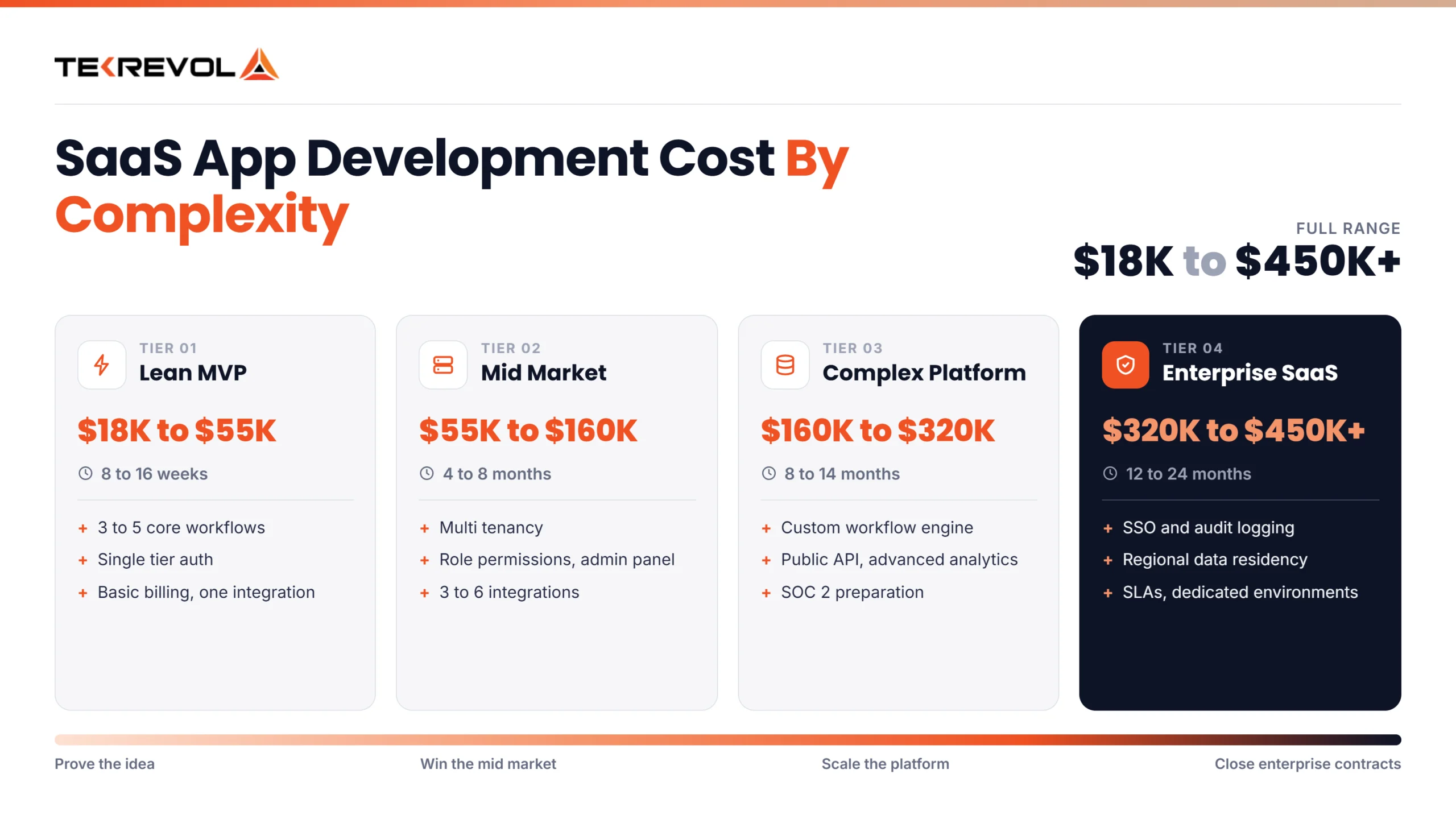
SaaS app development cost in 2026 ranges from $18,000 to $450,000 or more. A lean MVP with a handful of core workflows costs $18,000 to $55,000. Mid-market platforms run $55,000 to $160,000. Enterprise-grade, compliance-heavy products start around $160,000 and climb past $450,000.
Here’s how the four common build tiers shake out.
| Build Tier | Typical Cost | Timeline | What You Get |
| Lean MVP | $18,000 – $55,000 | 8 – 16 weeks | 3 to 5 core workflows, single-tier authentication, basic billing, and one integration |
| Mid-Market SaaS | $55,000 – $160,000 | 4 – 8 months | Multi-tenancy, role permissions, admin panel, 3 to 6 integrations, and reporting |
| Complex Platform | $160,000 – $320,000 | 8 – 14 months | Custom workflow engine, customer API, advanced analytics, and SOC 2 preparation |
| Enterprise SaaS | $320,000 – $450,000+ | 12 – 24 months | SSO, audit logging, regional data residency, SLAs, and dedicated environments |
One caveat worth stating plainly. Nobody can quote your build off a paragraph description. These brackets tell you which conversation you’re in, and the real quote comes once somebody writes down your user roles, your data model, and your integrations.
Still guessing what your SaaS build will actually cost?
Send us your feature list, and we'll come back with a phase-by-phase estimate, a realistic timeline, and the line items most quotes quietly leave out.
Get Your Free SaaS Cost Breakdown →What Does the SaaS App Development Cost Breakdown Look Like?
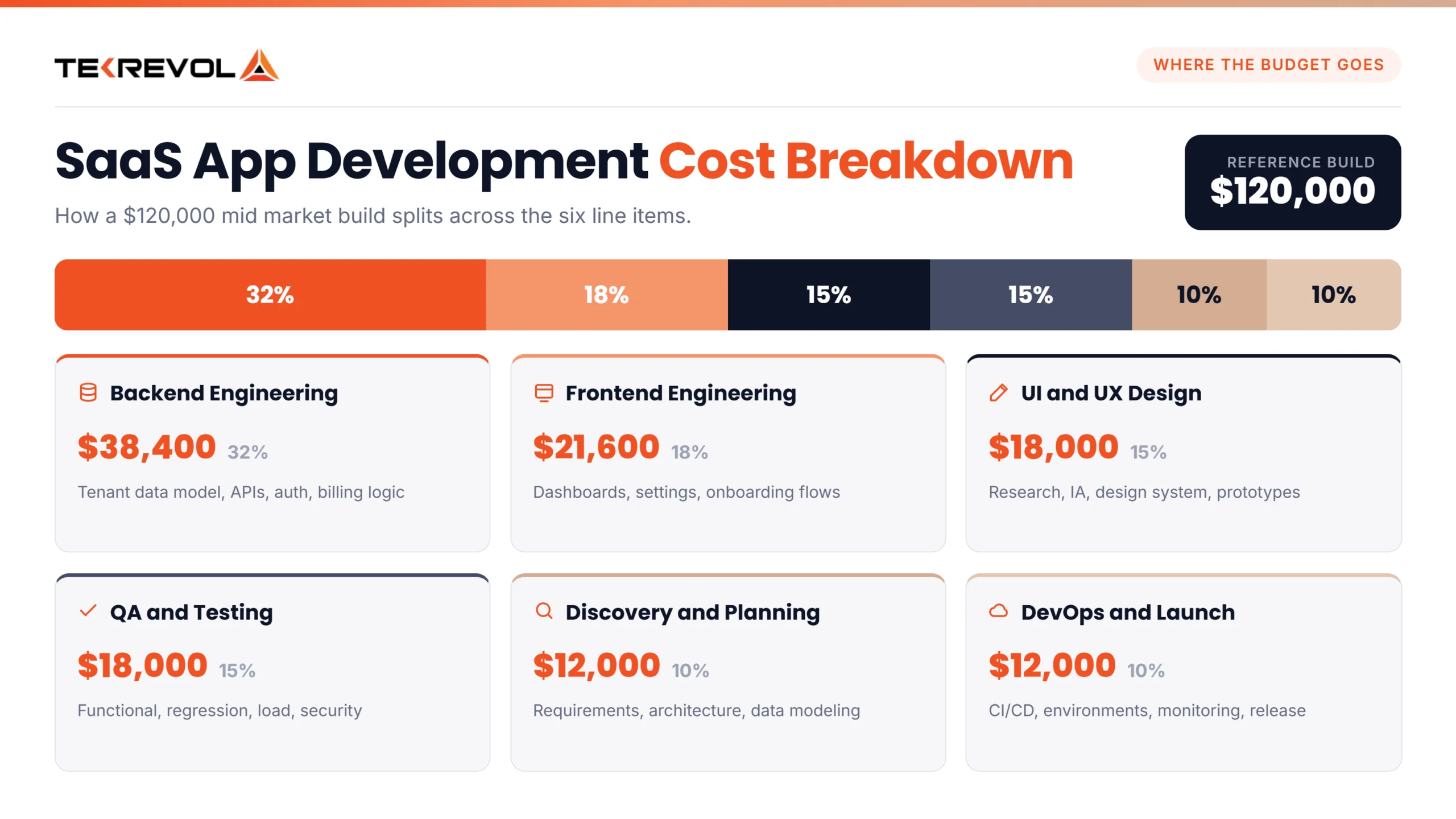
The SaaS app development cost breakdown splits into five buckets. Engineering takes about 50 percent, design 15 percent, QA 15 percent, discovery 10 percent, and deployment the final 10 percent. Those proportions hold surprisingly well across budget sizes.
Take a $120,000 mid-market build.
| Line Item | Share of Budget | Dollar Amount | What It Covers |
| Backend Engineering | 32% | $38,400 | Multi-tenant data model, APIs, authentication, billing logic, and business rules |
| Frontend Engineering | 18% | $21,600 | Application UI, dashboards, settings, and onboarding flows |
| UI/UX Design | 15% | $18,000 | Research, information architecture, wireframes, design system, and prototypes |
| QA and Testing | 15% | $18,000 | Functional, regression, load, and security testing across releases |
| Discovery and Planning | 10% | $12,000 | Requirements, technical architecture, data modeling, and roadmap |
| DevOps and Launch | 10% | $12,000 | CI/CD pipelines, environments, monitoring, and production release |
The backend share is the part founders underestimate most. A multi-tenant SaaS platform has to isolate hundreds of customers inside shared infrastructure, then let each of them invite users, set permissions, and export their own data without ever touching anyone else’s.
That work happens before a single customer-facing screen exists, and it’s why two apps that look identical can differ by $40,000 under the hood. Our detailed guide to building a SaaS platform from the ground up covers that architectural layer if you want the engineering view rather than the budget view.
How Much Does SaaS Development Cost by Product Stage?
SaaS costs by product stage follow your company’s maturity, not your feature list. Validation runs $18,000 to $55,000. Product-market fit runs $55,000 to $160,000. Scale runs $160,000 to $320,000. Enterprise readiness starts at $320,000 and keeps going.
Phases repeat inside every release. Stages happen once, in order, as the business grows. Mixing them up is why founders sometimes budget an enterprise product for a validation-stage company.
| Product Stage | Investment | Goal | Right Call |
| Validation | $18,000 – $55,000 | Prove someone will pay | Ship 3 to 5 workflows, one customer segment, manual onboarding |
| Product-Market Fit | $55,000 – $160,000 | Reduce churn, prove retention | Add self-serve billing, permissions, the 3 most-requested integrations |
| Scale | $160,000 – $320,000 | Support growth without rewrites | Performance work, analytics, public API, SOC 2 |
| Enterprise Readiness | $320,000+ | Close six-figure contracts | SSO, audit trails, SLAs, data residency, procurement support |
Validation-stage founders should also know that the approach of a good MVP development company to building is not a cheap version of the real thing. It’s the smallest complete product that solves one problem properly for one customer type.
Not sure whether you need an MVP or the full platform?
Book a 30-minute session, and we'll scope your first release, tell you honestly what can wait, and show you exactly where the budget goes.
Book Your Free SaaS Scoping Session →Which Factors Affect SaaS App Development Cost the Most?
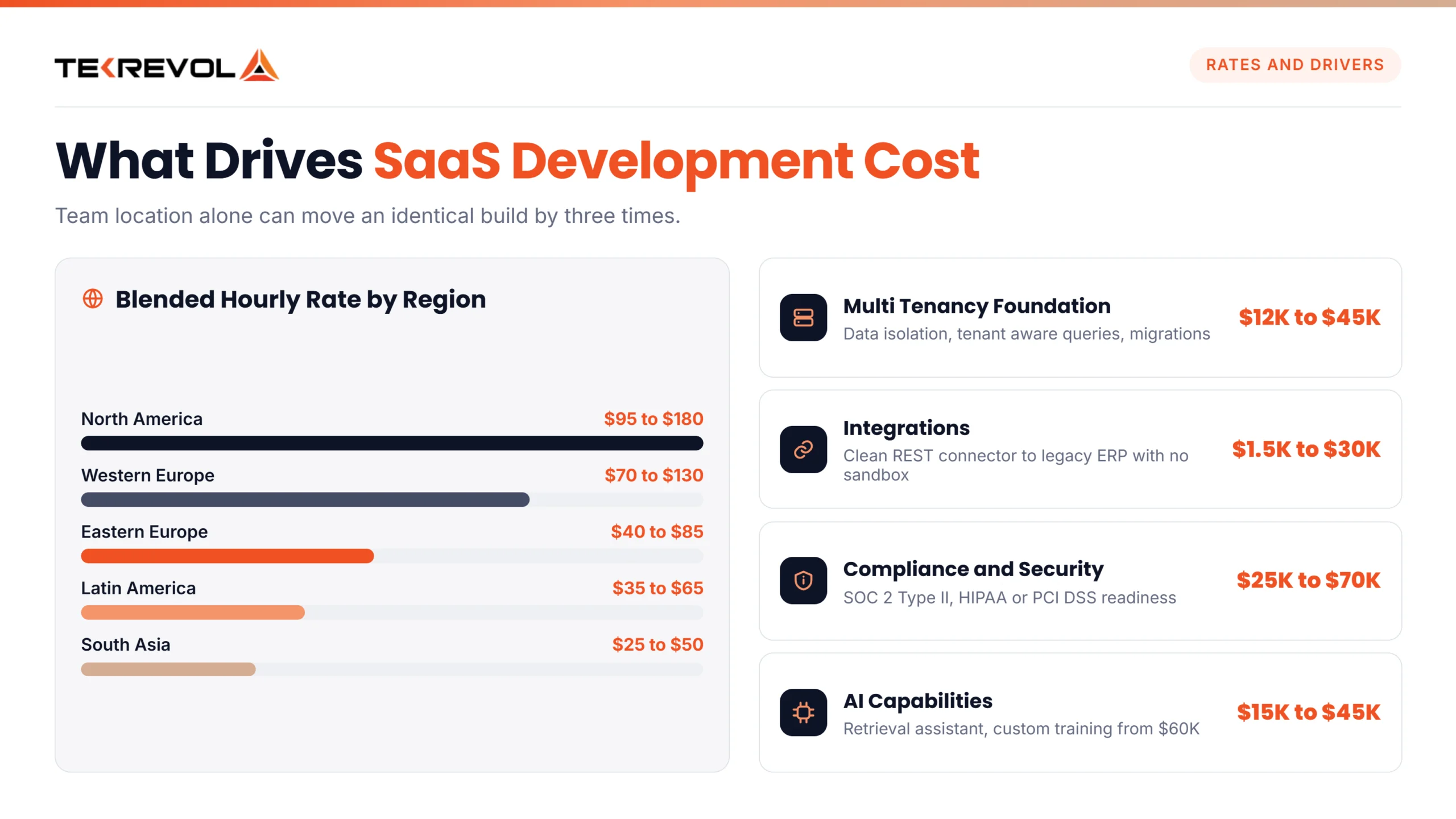
The factors that affect SaaS app development cost most are feature complexity, multi-tenancy architecture, third-party integrations, team location and seniority, compliance requirements, and AI capabilities. Team location alone can swing an identical build by three times.
Team Location and Rates
Where your team sits is the largest single variable, and the one you control most directly.
| Region | Blended Hourly Rate | Same $120K Build Costs |
| North America | $95 – $180 | $180,000 – $340,000 |
| Western Europe | $70 – $130 | $130,000 – $245,000 |
| Eastern Europe | $40 – $85 | $75,000 – $160,000 |
| Latin America | $35 – $65 | $66,000 – $122,000 |
| South Asia | $25 – $50 | $47,000 – $94,000 |
In-house changes the math again. The U.S. The Bureau of Labor Statistics reported a median annual wage of $131,450 for software developers, QA analysts, and testers in May 2024, and that’s base pay before benefits, equipment, and recruiting.
A four-person team runs past $700,000 a year fully loaded. Teams that want senior engineers without permanent headcount often use dedicated development teams through IT staff augmentation for the build, then hire once revenue is predictable.
Feature Complexity and Multi-tenancy
Multi-tenancy is the decision that separates SaaS from ordinary software, and it’s expensive. Data isolation, per-tenant configuration, tenant-aware queries, and safe schema migrations across thousands of accounts all have to work before your first customer logs in. Budget $12,000 to $45,000 for that foundation.
Integrations and Platform Reach
Every integration is a small project. A clean REST connector runs $1,500 to $5,000. A legacy ERP with no sandbox runs $8,000 to $30,000 and takes longer than anyone promised. Native mobile widens the surface again, which is why teams needing web and mobile often bring in a mobile app development company rather than stretching one team across three platforms.
Compliance and security
SOC 2 Type II preparation adds $25,000 to $70,000 across engineering work, policy documentation, and audit fees. HIPAA and PCI DSS land in similar territory. Regulated buyers don’t treat this as optional, so selling into healthcare or finance means budgeting for it now, not later.
AI capabilities
A retrieval-based assistant over your own data costs $15,000 to $45,000 to build well, and custom model training starts near $60,000. Unlike a normal feature, it keeps costing money monthly through inference charges. Our artificial intelligence development service team scopes these separately because build cost and run cost behave completely differently.
How Much Does SaaS Cost by App Type?
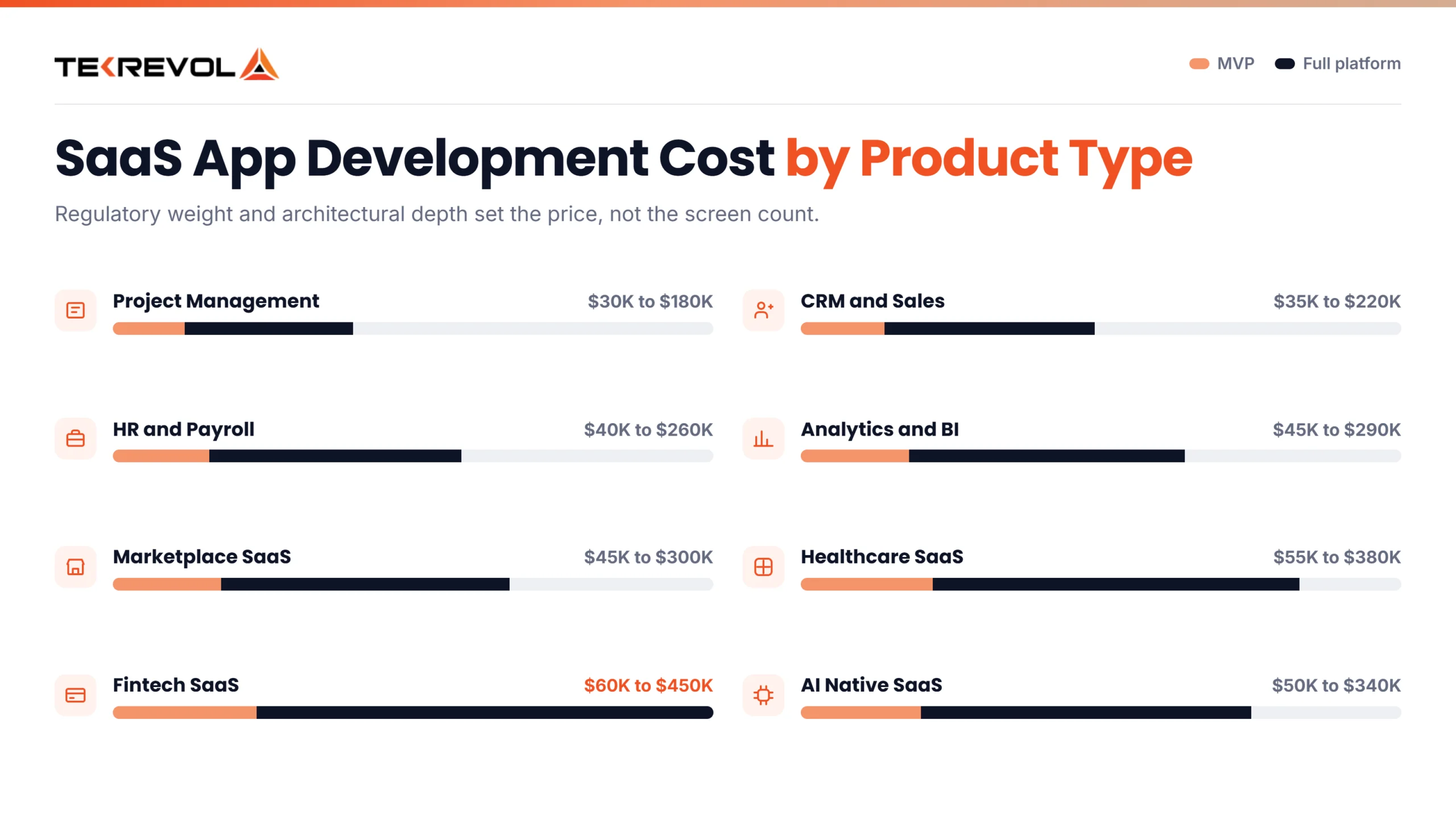
SaaS costs by app type vary widely because different categories carry different regulatory and architectural weight. A project management tool starts near $30,000. A fintech or healthcare platform rarely finishes under $95,000. Marketplace and analytics products sit between those poles.
| SaaS App Type | MVP Cost | Full Platform | Main Cost Driver |
| Project Management/Collaboration | $30,000 – $55,000 | $90,000 – $180,000 | Real-time sync, permissions, notifications |
| CRM and Sales Tools | $35,000 – $65,000 | $110,000 – $220,000 | Data model depth, email and calendar integrations |
| HR and Payroll | $40,000 – $75,000 | $130,000 – $260,000 | Regional tax rules, compliance, payroll accuracy |
| Analytics and BI | $45,000 – $85,000 | $140,000 – $290,000 | Data pipelines, query performance, visualization |
| Marketplace SaaS | $45,000 – $90,000 | $150,000 – $300,000 | Two-sided flows, payments, trust and safety |
| Healthcare SaaS | $55,000 – $110,000 | $180,000 – $380,000 | HIPAA, audit logging, clinical workflows |
| Fintech SaaS | $60,000 – $120,000 | $200,000 – $450,000 | PCI DSS, KYC, ledger accuracy, fraud checks |
| AI-Native SaaS | $50,000 – $95,000 | $160,000 – $340,000 | Model integration, data pipelines, inference cost |
Notice the pattern. The categories at the bottom of the table cost more because of what happens when they break. A collaboration tool with a bug annoys people. A payroll tool with a bug pays someone the wrong amount, and a clinical tool with a bug reaches a patient. That risk profile is priced into every hour of QA and every layer of audit logging.
How Much Does It Cost to Build a SaaS Application on AWS Cloud?
AWS is one of the most loved choices for deploying SaaS platforms because of its reliability and flexibility. But understanding the monthly costs is also necessary for managing your SaaS application costs.
Commute EC2
Amazon EC2 is the backbone of many SaaS products. Depending on the size and configuration, prices typically range from $50 – $200 per month for mid-level servers.
Database (RDS)
If your SaaS application needs a managed database, AWS RDS is the real go-to option. Expect monthly charges of about $30 – $100, depending on the engine, storage, and usage of the database.
Storage (S3)
AWS S3 offers highly durable and secure object storage. Costs start at $0.023 per GB stored, and they scale based on how much data your application manages.
Other Services (CloudFront, Lambda, Route 53)
Other AWS services like CloudFront (CDN), Lambda (serverless functions), and Route 53 (DNS management) can differ a lot in SaaS application cost depending on traffic and usage patterns.
Average Monthly AWS Cost: For a mid-sized SaaS application, the monthly AWS bill typically falls between $300 – $1000. As your app scales and user demand grows, this number can even climb much higher, especially if you introduce advanced services or larger infrastructure needs.
What Hidden Costs Do SaaS Founders Miss?
Hidden SaaS costs arrive after launch and never leave. Cloud infrastructure, third-party licenses, security monitoring, support tooling, and ongoing maintenance typically add 15 to 25 percent of your original build cost, every year, indefinitely.
Here’s what a mid-market SaaS product pays annually once it’s live.
| Ongoing Cost | Annual Range | Why It Exists |
| Cloud Infrastructure | $4,800 – $36,000 | Compute, storage, database, bandwidth, backups |
| Maintenance and Updates | $12,000 – $40,000 | Dependency updates, bug fixes, small improvements |
| Third-Party Licenses | $3,600 – $24,000 | Payments, email, analytics, monitoring, error tracking |
| Security and Compliance | $8,000 – $45,000 | Penetration tests, audit renewals, monitoring tools |
| Support Tooling and Staffing | $6,000 – $60,000 | Helpdesk software, documentation, support headcount |
| AI Inference Costs | $2,400 – $80,000+ | Scales with usage, not with your customer count |
Traditional software costs scale with customers you have. AI costs scale with how much they use it, and your heaviest users can end up as your least profitable ones. Price accordingly, and instrument usage from day one.
How Can You Reduce SaaS App Development Cost Without Hurting the Product?
You can reduce SaaS app development cost by cutting scope rather than quality. Ship fewer features properly, defer non-core integrations, use managed cloud services instead of custom infrastructure, and pick a blended team model. Together, these usually save 30 to 45 percent.
Ruthlessly cut your first release
Write down every feature, then ask one question of each: can we get a paying customer without this? Most lists shrink by half. What survives goes in version one, and the rest goes on a roadmap where it belongs.
Use managed services for solved problems
Authentication, payments, email delivery, and file storage are commodities. Building your own auth system costs $8,000 to $20,000 and gives you nothing a customer pays extra for. Wire in a proven provider instead.
Pick a blended team model
A senior architect in your timezone plus a delivery team in a lower-cost region usually beats both extremes. Our cloud services and infrastructure consultants set the environment up once at the start, which prevents the expensive rework that catches teams around month six.
Automate testing early
It looks like an added cost in month two. By month eight, when manual regression testing would eat three days per release, it’s the reason you can still ship weekly.
Reuse instead of reinventing
Design systems, component libraries, and proven backend patterns cut development time sharply. If mobile access is on the roadmap, cross-platform development services deliver iOS and Android from one codebase instead of funding two builds.
Instrument before you optimize
Add usage analytics in the first release. Six months of real data tells you which features to invest in and which to quietly retire. That single habit saves more than any negotiation over hourly rates. Still narrowing down what to build? Our roundup of product ideas for SaaS startups is a decent place to start.
Which Market Trends Are Changing SaaS Development Costs in 2026?
SaaS development is getting cheaper for standard features and more expensive for advanced requirements. Mature frameworks and AI tools reduce build time, while AI integrations, compliance, and usage-based infrastructure add new costs.
The market is growing fast. Statista projects global SaaS revenue to reach $488.53 billion in 2026, while Gartner forecasts $1.44 trillion in worldwide software spending this year.
Four trends are shaping SaaS app development costs in 2026:
- AI is becoming standard: Copilots, automation, and intelligent search add development and ongoing API costs.
- Compliance starts earlier: Enterprise buyers increasingly expect security controls, audit logs, and compliance readiness before launch.
- Standard features cost less: Mature frameworks and ready-made services speed up authentication, billing, and other common functionality.
- Usage costs keep growing: AI APIs and cloud services can turn inefficient architecture into a recurring expense. A 2026 Forbes Technology Council report noted that 78% of IT leaders faced unexpected AI or consumption charges.
Why Choose TekRevol for SaaS App Development?
TekRevol builds SaaS products for companies that need the platform working on day one, not eventually. We’ve delivered 800-plus projects with a team of 500-plus professionals, and we scope every SaaS engagement around multi-tenancy, compliance, and total cost of ownership rather than screen counts.
Three things shape how we work on SaaS specifically:
- We scope the run cost, not just the build cost. Your estimate covers what the product costs to operate in year one and year two, so the budget conversation happens before launch.
- Architecture decisions come first. Tenancy model, data isolation, and permissions get settled in discovery, because those are the choices that turn into rewrites when deferred.
- You own everything. Code, infrastructure, documentation, and credentials are yours. No proprietary lock-in, no platform you can’t leave.
We’ll also tell you when the answer is a smaller build. For the wider commercial picture, our breakdown of the cost of SaaS application development across models and markets goes deeper on pricing and monetization.
Ready to put a real number on your SaaS idea?
Talk to the team that's shipped multi-tenant platforms across healthcare, logistics, and B2B operations. Just an honest read on scope, cost, and risk.
Schedule Your Free SaaS Consultation →


![Real Estate App Development Cost in 2026 [Breakdown by Features & MLS Integration]](https://d3r5yd0374231.cloudfront.net/images-tek/uploads/2023/04/Feature-Image-6-400x226.png)


